




Lun - Sam, 7h30 - 19h30

Ventes et Support- service@mechnician.com

Téléphone- (888) 641-6324

Professional SCR System Troubleshooting: A Data-Driven Diagnostic Guide

Professional SCR System Troubleshooting: A Data-Driven Diagnostic Guide

What if the dreaded "countdown to shutdown" on your dashboard isn't a sign of mechanical failure, but a data validation error you can resolve without a dealer visit? It's a scenario every fleet owner and technician fears. An unpredictable emissions derate halts productivity and leads to expensive diagnostic fees. The confusion between a failing NOx sensor and poor DEF quality often results in unnecessary parts replacement and hours of lost time.

You deserve a more precise way to maintain your equipment. This guide will help you master professional SCR system troubleshooting by utilizing data-driven diagnostic protocols to identify the root cause of faults and clear derate conditions independently. We'll examine the latest EPA "Freedom to Fix" standards, technical SPN/FMI code interpretation, and the precise steps needed to validate NOx conversion efficiency using modern diagnostic software like Jaltest version 26.1. By shifting your focus from mechanical guesswork to systematic data analysis, you can ensure your fleet stays on the road and out of the service bay.

Key Takeaways

  • Understand the critical role of Selective Catalytic Reduction in meeting 2026 Tier 4 Final and Stage V emissions standards.
  • Learn to distinguish between fluid quality issues, sensor inaccuracies, and mechanical dosing failures to avoid replacing functional parts.
  • Master the interpretation of SPN and FMI codes within the J1939 protocol to perform precise SCR system troubleshooting.
  • Implement a structured diagnostic protocol that prioritizes full system scans and physical inspections to isolate root causes efficiently.
  • Gain the technical independence to clear derate conditions and manage emissions faults using professional Jaltest diagnostic kits.

SCR system troubleshooting is the precise process of identifying and resolving failures within the Selective Catalytic Reduction loop. For 2026 engines, this task is no longer just about fixing physical leaks or clogged lines. It's about data integrity. With the implementation of 2026 Tier 4 Final and Stage V emissions standards, the legal pressure on manufacturers has increased significantly. This pressure translates directly to the operator through stricter software monitoring and more aggressive fault detection.

Modern engines treat the "Emissions Derate" as a non-negotiable legal obligation. It isn't a hardware protection feature designed to save the engine from physical damage; it's a compliance mechanism. 2026 models feature enhanced data validation protocols for NOx conversion that are far more sensitive than previous generations. These systems are designed to detect not just total sensor failures, but subtle inaccuracies that suggest the catalyst isn't meeting its targets. Following the EPA's July 1, 2026 guidance, owners have more rights to access this diagnostic data, but the systems remain technically demanding. If the data points don't align perfectly, the engine's control logic will initiate a shutdown sequence.

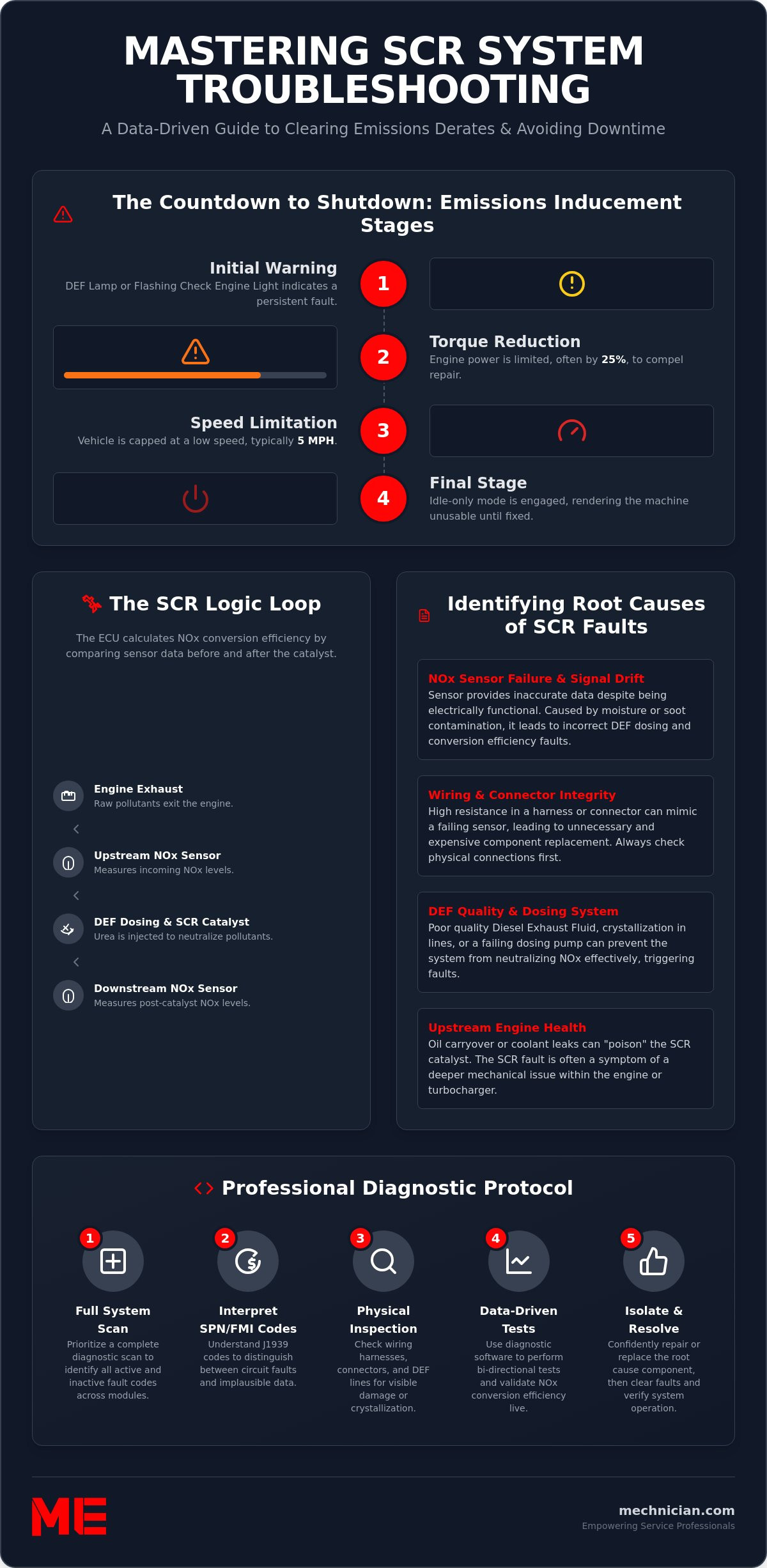
The SCR Logic Loop: How Your Engine Sees Emissions

The engine views the SCR system as a continuous mathematical equation. An upstream NOx sensor measures the raw pollutants exiting the engine, while a downstream "cleanup" sensor measures the final output after the catalyst. By comparing these two data points, the ECU calculates the "Conversion Efficiency." If the downstream sensor reports high NOx levels despite active DEF injection, the system flags a fault. The DEF dosing control unit manages this stoichiometric balance. It must inject the exact amount of urea required to neutralize pollutants without leaving excess ammonia. When this balance fails, SCR system troubleshooting becomes necessary to determine if the fault lies in the fluid, the sensors, or the catalyst itself.

Warning Stages and the Countdown to Shutdown

The transition from a minor fault to a full shutdown follows a disciplined sequence. It usually starts with a DEF Lamp or a flashing Check Engine light. If the fault persists, the engine enters the three stages of derate. First, you'll experience a torque reduction, which often limits power by 25 percent. If the issue isn't resolved, the software applies a speed limitation, typically capping the vehicle at 5 miles per hour. The final stage is an idle-only mode that effectively renders the machine useless. Emissions Inducement is a programmed software strategy that progressively degrades engine performance to compel the operator to repair emissions-related faults. Understanding these stages is critical for maintaining operational stability and avoiding total downtime.

The Primary Culprits: Identifying the Root Cause of SCR Faults

Effective SCR system troubleshooting requires moving beyond simple part replacement. While a "circuit open" code points directly to a severed wire or a dead component, "implausible data" codes represent the real challenge for technicians. These faults occur when a sensor is electrically functional but reports values that don't align with the engine's operating logic. Distinguishing between a failed component and a wiring harness integrity issue is the first step in a professional diagnostic process. High resistance in a connector can mimic a failing sensor, leading many to replace expensive parts unnecessarily.

We must also consider the health of the engine upstream. The SCR catalyst is a sensitive chemical reactor. If the engine experiences oil carryover or internal coolant leaks, these fluids eventually reach the aftertreatment system. Oil soot can coat the catalyst substrate, while coolant can cause thermal shock or chemical "poisoning." In these cases, the SCR fault is merely a symptom of a deeper mechanical issue within the engine block or turbocharger. Success depends on viewing the exhaust stream as a continuous data set rather than a series of isolated parts.

NOx Sensor Failure and Signal Drift

The most common "invisible" failure is sensor drift. A drifted sensor provides a voltage signal that the ECU accepts as valid, but the data is inaccurate. For example, a sensor might report 50ppm of NOx when the actual output is 200ppm. This discrepancy causes the ECU to miscalculate the required DEF dose, eventually triggering a conversion efficiency fault. Moisture or soot contamination typically "poisons" the ceramic sensing element over time. To identify this, technicians should use specialized diagnostic cables and software to perform bi-directional response time tests, which reveal if a sensor has become "lazy" or unresponsive to exhaust changes.

DEF Quality and Contamination Issues

Diesel Exhaust Fluid is a precise mixture of 32.5 percent high-purity urea and deionized water. If this concentration shifts due to age or evaporation, the system's chemical balance fails. Even if the tank is full, the ECU will trigger a fault if the NOx reduction doesn't meet the expected map. Using a refractometer is the only reliable way to verify fluid integrity. Contamination is another critical factor. Even a few drops of diesel fuel or engine oil in the DEF tank can damage the urea quality sensor and destroy the dosing pump's internal seals.

Dosing System and DEF Pump Failures

Mechanical failures often center on the dosing valve and the supply pump. Crystallization, often called the "white death," occurs when DEF dries inside the injector or lines, creating stubborn blockages. This is frequently caused by a failed purge cycle, where the system fails to vacuum the lines empty after the engine stops. Monitoring pump pressure fluctuations during operation can help you identify a failing pump before it reaches a total shutdown state. In cold climates, verifying the heating circuit's integrity is essential to ensure fluid remains liquid and flows correctly through the system.

Interpreting SCR Diagnostic Data: SPN and FMI Codes

Professional SCR system troubleshooting requires a deep understanding of the J1939 communication protocol. Unlike passenger vehicles that rely on generic P-codes, heavy-duty and off-highway equipment use Suspect Parameter Numbers (SPN) and Failure Mode Identifiers (FMI). A generic OBD-II reader might tell you there's an emissions fault, but it won't provide the granularity needed to fix it. It might show a broad "NOx Sensor" error, whereas a professional tool identifies exactly which sensor is failing and whether the fault is electrical, mechanical, or data-driven.

The FMI is particularly critical because it defines the nature of the failure. For instance, an FMI 3 indicates voltage is above normal, while an FMI 10 suggests an abnormally high rate of change. Without this context, you're just guessing. To truly master the diagnostic process, you must also utilize "Freeze Frame" data. This captures the exact engine conditions at the moment the fault was triggered, such as engine load, exhaust temperature, and DEF pressure. This data is the only reliable way to identify intermittent electrical glitches that disappear as soon as the machine enters the shop.

Common SCR Fault Code Structures

Two specific codes appear frequently in modern aftertreatment systems. SPN 3226 relates to the downstream NOx sensor. If you see this with FMI 2 (erratic data), it often points to sensor "poisoning" or a wiring issue rather than a total sensor death. SPN 5394 identifies problems with the DEF dosing valve. In these cases, you must verify if the failure is electrical, such as a solenoid coil issue, or mechanical, like a crystallized blockage. For a deeper look at the protocols used in these systems, consult our Professional Vehicle Diagnostic Tool Guide, which outlines the 2026 industry standards for data communication.

Cross-Correlating Data Parameters

Diagnostic success isn't about reading one code; it's about correlating multiple data streams. For example, the ECU will only initiate DEF dosing when exhaust temperatures reach a specific threshold, typically around 200 degrees Celsius. If your software shows zero dosing, check the temperature sensors first. If the exhaust is too cool, the system is working correctly by inhibiting dosing to prevent crystallization. Similarly, compare the DEF tank header temperature against ambient air temperature. If the tank is reporting 50 degrees Celsius on a freezing day, the heater circuit is likely stuck on. Finally, always monitor the "NOx Conversion Efficiency" percentage. In a healthy 2026 engine, this should consistently stay above 80 percent during steady-state operation. If this number drops while dosing is active, you're looking at a degraded catalyst or poor fluid quality.
SCR system troubleshooting

Professional SCR Troubleshooting Protocol: A Step-by-Step Guide

Executing a disciplined workflow is the only way to avoid the trap of "parts cannon" repairs. Professional SCR system troubleshooting begins with a full system scan to categorize codes as active or inactive. Active codes are your immediate priority; they represent the current roadblocks preventing normal operation. Inactive codes, however, provide a historical map of intermittent failures that might suggest a fraying wire or a loose connector. You can't fix what you haven't fully mapped.

Once you've scanned the system, move to a physical inspection. Look for white urea crystals around the dosing valve or pump, which indicate leaks or poor purge cycles. Check the aftertreatment harness for rub points against the chassis. Next, validate the DEF quality. A refractometer is essential here; the urea concentration must be exactly 32.5 percent. If the fluid is contaminated or degraded, no amount of sensor replacement will clear the fault. If the fluid passes, proceed to bi-directional tests to verify the pump and injector. The final step involves a system reset and a NOx sensor calibration via your software to ensure the ECU recognizes the new operating parameters.

The Importance of Bi-Directional Testing

Bi-directional testing allows you to command the DEF pump to build pressure without running the engine. This isolation is critical for identifying weak pumps or internal blockages. During a "Quantity Test," you'll measure the actual volume of fluid delivered by the injector into a graduated cylinder. A successful dosing test is the gold standard for hardware validation because it confirms the entire mechanical loop is physically capable of delivering fluid. If the hardware delivers the correct volume but the fault remains, your problem is likely electronic or chemical.

Clearing the Derate: The Software Handshake

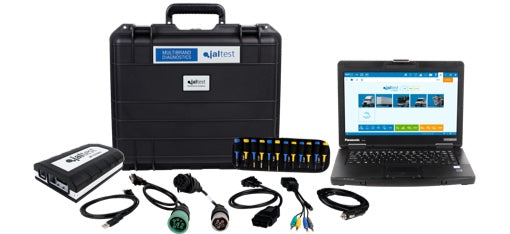
Simply hitting "clear codes" won't exit a heavy-duty engine from an emissions derate. The ECU requires a successful "Efficiency Test" or a specific "Software Handshake" to prove the repair worked. Using the Jaltest CV Kit, you can initiate these forced system resets and monitor the progress in real time. Be aware of software inhibitors; the test won't start unless all "Interlock" conditions are met. This typically includes reaching a specific coolant temperature and ensuring the parking brake is set. To equip your shop with these professional capabilities, you can browse our complete range of diagnostic kits and ruggedized laptops designed for industrial environments.

Eliminating Dealer Dependency with Jaltest Diagnostic Solutions

Many fleet operators believe they're permanently locked into dealer service cycles for emissions repairs. This misconception often leads to unnecessary towing costs and days of lost productivity while waiting for a service slot. However, the EPA's July 1, 2026 "Freedom to Fix" guidance has reinforced the right for independent shops and owners to access the same level of diagnostic data as franchised dealers. Mechnician empowers your team by providing the tools necessary to perform advanced SCR system troubleshooting without external reliance. By using Jaltest version 26.1 software, you gain the ability to communicate with the engine control module just as a factory technician would.

The primary advantage of Jaltest OHW and CV kits is their multi-brand coverage. Whether you're managing a Cummins engine in a truck or a Volvo power unit in an excavator, a single interface handles the entire fleet. You don't need a dozen different OEM subscriptions or proprietary cables. The software integrates technical data, wiring diagrams, and component locations directly into the diagnostic flow. If you're looking for the DEF dosing valve or a specific NOx sensor connector, the software shows you exactly where it is on the chassis. This integrated approach allows you to perform SCR calibrations and efficiency tests on-site, immediately after the physical repair is complete.

The Mechnician Advantage: Beyond the Tool

Owning the hardware is only half of the solution. Mechnician provides a professional support ecosystem to ensure your success in complex SCR system troubleshooting scenarios. If you encounter a fault code that doesn't follow standard logic, our remote technical support can assist in interpreting the data stream. We also prioritize professional development through Jaltest University training, which covers the nuances of modern Stage V and Tier 4 Final systems. For businesses looking to upgrade their shop capabilities, we offer flexible financing options for acquiring full ruggedized diagnostic bundles, including laptops and specialized cables.

Future-Proofing Your Fleet Maintenance

Transitioning to an all-makes diagnostic strategy is a conscious decision for long term stability. Instead of reacting to a "countdown to shutdown," you can use Jaltest software to monitor SCR health trends during routine maintenance. By checking NOx conversion percentages and pump pressure stability before a fault occurs, you can identify a failing component during scheduled downtime. This proactive stance transforms technical oversight from a recurring expense into a strategic asset. Stop paying for dealer lockouts and take control of your uptime. Explore Jaltest Diagnostic Kits at Mechnician to find the right solution for your equipment.

Mastering Your Fleet's Operational Stability

Transitioning to internal diagnostics is a strategic shift toward long-term sustainability and reduced downtime. You've learned that effective SCR system troubleshooting requires a move away from trial-and-error part replacement toward a rigorous data-driven validation process. By interpreting SPN and FMI codes and executing bi-directional dosing tests, you can resolve the complex "implausible data" faults that often baffle standard shops. This systematic approach ensures that every repair is backed by technical evidence rather than guesswork.

As an Authorized Jaltest Dealer, Mechnician provides the precise tools needed to maintain compliance with 2026 emissions standards. Our ruggedized diagnostic laptop bundles and expert remote technical support ensure your technicians have the resources to handle any aftertreatment challenge directly in your own facility. Investing in these capabilities doesn't just save on dealer fees; it secures your organization's operational independence.

Take control of your emissions repairs with a Jaltest Kit from Mechnician.

With the right data and professional-grade equipment, the "countdown to shutdown" becomes a manageable technical task rather than a financial crisis. Your fleet's continuous operation is now within your direct control.

Frequently Asked Questions

Why does my truck say 'SCR System Fault' but I have plenty of DEF?

An SCR System Fault indicates a chemical or data failure in the reduction loop, not necessarily a low fluid level. The ECU calculates the conversion efficiency by comparing upstream and downstream NOx readings. If the reduction is insufficient due to a degraded catalyst or a drifted sensor, the system flags a fault even if the DEF tank is completely full. Systematic SCR system troubleshooting is required to identify which sensor or component is reporting the mismatch.

Can a bad NOx sensor cause my engine to go into limp mode?

A malfunctioning NOx sensor is a primary trigger for emissions inducement, commonly known as limp mode. If the ECU receives erratic or out-of-range data from these sensors, it can't verify emissions compliance. To ensure the engine meets legal standards, the software will progressively reduce torque and vehicle speed until the sensor is replaced and the system is recalibrated. This is a legal requirement for 2026 engines to prevent excessive pollutants.

How do I know if my DEF fluid is contaminated or just old?

You can accurately determine fluid integrity by using a professional refractometer to measure the urea concentration. High-quality Diesel Exhaust Fluid must maintain a 32.5 percent urea concentration to function correctly. If the reading is lower, the fluid has aged and the water has evaporated. If the fluid appears cloudy or smells like diesel, it's contaminated and requires a complete system flush to prevent pump damage.

Is it possible to clear an SCR derate code with a basic code reader?

Basic code readers lack the bi-directional capabilities required to perform the software handshake needed to exit a derate. While a generic tool might clear the "Check Engine" light temporarily, the ECU won't lift the speed or torque limitations until it sees a successful efficiency test. Professional SCR system troubleshooting requires tools that can command the system to perform these specific reset and calibration procedures.

What is a 'dosing test' and why is it necessary for troubleshooting?

A dosing test is a manual command that forces the DEF pump to build pressure and the injector to spray a measured volume of fluid. It's necessary because it isolates the mechanical components from the engine's software logic. By measuring the output in a graduated cylinder, you can confirm if the pump and injector are physically capable of meeting the dosing requirements without the engine running.

Will a faulty DPF system cause an SCR system fault?

A failure in the DPF system can indirectly trigger SCR faults by altering exhaust temperatures or increasing soot loading. If the DPF is clogged, it may prevent the exhaust from reaching the 200 degree Celsius threshold required for SCR operation. This thermal imbalance often leads to crystallization in the dosing valve, which then requires extensive cleaning or component replacement to resolve the resulting emissions codes.

How much does it cost to replace a NOx sensor vs. repairing the harness?

Repairing a damaged wiring harness is significantly more cost-effective than replacing a functional NOx sensor. Technicians often find that "sensor failure" codes are actually caused by high resistance in a corroded connector or a pinched wire. Performing a continuity test on the harness before purchasing new components is a standard protocol that prevents unnecessary spending on expensive electronic parts that aren't actually broken.

Do I need a specific diagnostic cable for SCR troubleshooting on a Mack or Volvo truck?

Mack and Volvo trucks frequently utilize proprietary communication pins that require specialized diagnostic cables for full system access. While a standard 9-pin connector might provide basic engine data, you'll need the correct 8-pin or specialized OBD-II cable to perform SCR resets and calibrations. Jaltest kits are specifically designed to include these connectors so you aren't locked out of dealer-level functions on these specific brands.
Laissez un commentaire

Veuillez noter que les commentaires doivent être approvés avant d'être affichés

Ce site est protégé par hCaptcha, et la Politique de confidentialité et les Conditions de service de hCaptcha s’appliquent.


Professional SCR System Troubleshooting: A Data-Driven Diagnostic Guide

Professional SCR System Troubleshooting: A Data-Driven Diagnostic Guide

What if the dreaded "countdown to shutdown" on your dashboard isn't a sign of mechanical failure, but a data validation error you can resolve without a dealer visit? It's a scenario every fleet owner and technician fears. An unpredictable emissions derate halts productivity and leads to expensive diagnostic fees. The confusion between a failing NOx sensor and poor DEF quality often results in unnecessary parts replacement and hours of lost time.

You deserve a more precise way to maintain your equipment. This guide will help you master professional SCR system troubleshooting by utilizing data-driven diagnostic protocols to identify the root cause of faults and clear derate conditions independently. We'll examine the latest EPA "Freedom to Fix" standards, technical SPN/FMI code interpretation, and the precise steps needed to validate NOx conversion efficiency using modern diagnostic software like Jaltest version 26.1. By shifting your focus from mechanical guesswork to systematic data analysis, you can ensure your fleet stays on the road and out of the service bay.

Key Takeaways

  • Understand the critical role of Selective Catalytic Reduction in meeting 2026 Tier 4 Final and Stage V emissions standards.
  • Learn to distinguish between fluid quality issues, sensor inaccuracies, and mechanical dosing failures to avoid replacing functional parts.
  • Master the interpretation of SPN and FMI codes within the J1939 protocol to perform precise SCR system troubleshooting.
  • Implement a structured diagnostic protocol that prioritizes full system scans and physical inspections to isolate root causes efficiently.
  • Gain the technical independence to clear derate conditions and manage emissions faults using professional Jaltest diagnostic kits.

SCR system troubleshooting is the precise process of identifying and resolving failures within the Selective Catalytic Reduction loop. For 2026 engines, this task is no longer just about fixing physical leaks or clogged lines. It's about data integrity. With the implementation of 2026 Tier 4 Final and Stage V emissions standards, the legal pressure on manufacturers has increased significantly. This pressure translates directly to the operator through stricter software monitoring and more aggressive fault detection.

Modern engines treat the "Emissions Derate" as a non-negotiable legal obligation. It isn't a hardware protection feature designed to save the engine from physical damage; it's a compliance mechanism. 2026 models feature enhanced data validation protocols for NOx conversion that are far more sensitive than previous generations. These systems are designed to detect not just total sensor failures, but subtle inaccuracies that suggest the catalyst isn't meeting its targets. Following the EPA's July 1, 2026 guidance, owners have more rights to access this diagnostic data, but the systems remain technically demanding. If the data points don't align perfectly, the engine's control logic will initiate a shutdown sequence.

The SCR Logic Loop: How Your Engine Sees Emissions

The engine views the SCR system as a continuous mathematical equation. An upstream NOx sensor measures the raw pollutants exiting the engine, while a downstream "cleanup" sensor measures the final output after the catalyst. By comparing these two data points, the ECU calculates the "Conversion Efficiency." If the downstream sensor reports high NOx levels despite active DEF injection, the system flags a fault. The DEF dosing control unit manages this stoichiometric balance. It must inject the exact amount of urea required to neutralize pollutants without leaving excess ammonia. When this balance fails, SCR system troubleshooting becomes necessary to determine if the fault lies in the fluid, the sensors, or the catalyst itself.

Warning Stages and the Countdown to Shutdown

The transition from a minor fault to a full shutdown follows a disciplined sequence. It usually starts with a DEF Lamp or a flashing Check Engine light. If the fault persists, the engine enters the three stages of derate. First, you'll experience a torque reduction, which often limits power by 25 percent. If the issue isn't resolved, the software applies a speed limitation, typically capping the vehicle at 5 miles per hour. The final stage is an idle-only mode that effectively renders the machine useless. Emissions Inducement is a programmed software strategy that progressively degrades engine performance to compel the operator to repair emissions-related faults. Understanding these stages is critical for maintaining operational stability and avoiding total downtime.

The Primary Culprits: Identifying the Root Cause of SCR Faults

Effective SCR system troubleshooting requires moving beyond simple part replacement. While a "circuit open" code points directly to a severed wire or a dead component, "implausible data" codes represent the real challenge for technicians. These faults occur when a sensor is electrically functional but reports values that don't align with the engine's operating logic. Distinguishing between a failed component and a wiring harness integrity issue is the first step in a professional diagnostic process. High resistance in a connector can mimic a failing sensor, leading many to replace expensive parts unnecessarily.

We must also consider the health of the engine upstream. The SCR catalyst is a sensitive chemical reactor. If the engine experiences oil carryover or internal coolant leaks, these fluids eventually reach the aftertreatment system. Oil soot can coat the catalyst substrate, while coolant can cause thermal shock or chemical "poisoning." In these cases, the SCR fault is merely a symptom of a deeper mechanical issue within the engine block or turbocharger. Success depends on viewing the exhaust stream as a continuous data set rather than a series of isolated parts.

NOx Sensor Failure and Signal Drift

The most common "invisible" failure is sensor drift. A drifted sensor provides a voltage signal that the ECU accepts as valid, but the data is inaccurate. For example, a sensor might report 50ppm of NOx when the actual output is 200ppm. This discrepancy causes the ECU to miscalculate the required DEF dose, eventually triggering a conversion efficiency fault. Moisture or soot contamination typically "poisons" the ceramic sensing element over time. To identify this, technicians should use specialized diagnostic cables and software to perform bi-directional response time tests, which reveal if a sensor has become "lazy" or unresponsive to exhaust changes.

DEF Quality and Contamination Issues

Diesel Exhaust Fluid is a precise mixture of 32.5 percent high-purity urea and deionized water. If this concentration shifts due to age or evaporation, the system's chemical balance fails. Even if the tank is full, the ECU will trigger a fault if the NOx reduction doesn't meet the expected map. Using a refractometer is the only reliable way to verify fluid integrity. Contamination is another critical factor. Even a few drops of diesel fuel or engine oil in the DEF tank can damage the urea quality sensor and destroy the dosing pump's internal seals.

Dosing System and DEF Pump Failures

Mechanical failures often center on the dosing valve and the supply pump. Crystallization, often called the "white death," occurs when DEF dries inside the injector or lines, creating stubborn blockages. This is frequently caused by a failed purge cycle, where the system fails to vacuum the lines empty after the engine stops. Monitoring pump pressure fluctuations during operation can help you identify a failing pump before it reaches a total shutdown state. In cold climates, verifying the heating circuit's integrity is essential to ensure fluid remains liquid and flows correctly through the system.

Interpreting SCR Diagnostic Data: SPN and FMI Codes

Professional SCR system troubleshooting requires a deep understanding of the J1939 communication protocol. Unlike passenger vehicles that rely on generic P-codes, heavy-duty and off-highway equipment use Suspect Parameter Numbers (SPN) and Failure Mode Identifiers (FMI). A generic OBD-II reader might tell you there's an emissions fault, but it won't provide the granularity needed to fix it. It might show a broad "NOx Sensor" error, whereas a professional tool identifies exactly which sensor is failing and whether the fault is electrical, mechanical, or data-driven.

The FMI is particularly critical because it defines the nature of the failure. For instance, an FMI 3 indicates voltage is above normal, while an FMI 10 suggests an abnormally high rate of change. Without this context, you're just guessing. To truly master the diagnostic process, you must also utilize "Freeze Frame" data. This captures the exact engine conditions at the moment the fault was triggered, such as engine load, exhaust temperature, and DEF pressure. This data is the only reliable way to identify intermittent electrical glitches that disappear as soon as the machine enters the shop.

Common SCR Fault Code Structures

Two specific codes appear frequently in modern aftertreatment systems. SPN 3226 relates to the downstream NOx sensor. If you see this with FMI 2 (erratic data), it often points to sensor "poisoning" or a wiring issue rather than a total sensor death. SPN 5394 identifies problems with the DEF dosing valve. In these cases, you must verify if the failure is electrical, such as a solenoid coil issue, or mechanical, like a crystallized blockage. For a deeper look at the protocols used in these systems, consult our Professional Vehicle Diagnostic Tool Guide, which outlines the 2026 industry standards for data communication.

Cross-Correlating Data Parameters

Diagnostic success isn't about reading one code; it's about correlating multiple data streams. For example, the ECU will only initiate DEF dosing when exhaust temperatures reach a specific threshold, typically around 200 degrees Celsius. If your software shows zero dosing, check the temperature sensors first. If the exhaust is too cool, the system is working correctly by inhibiting dosing to prevent crystallization. Similarly, compare the DEF tank header temperature against ambient air temperature. If the tank is reporting 50 degrees Celsius on a freezing day, the heater circuit is likely stuck on. Finally, always monitor the "NOx Conversion Efficiency" percentage. In a healthy 2026 engine, this should consistently stay above 80 percent during steady-state operation. If this number drops while dosing is active, you're looking at a degraded catalyst or poor fluid quality.

SCR system troubleshooting

Professional SCR Troubleshooting Protocol: A Step-by-Step Guide

Executing a disciplined workflow is the only way to avoid the trap of "parts cannon" repairs. Professional SCR system troubleshooting begins with a full system scan to categorize codes as active or inactive. Active codes are your immediate priority; they represent the current roadblocks preventing normal operation. Inactive codes, however, provide a historical map of intermittent failures that might suggest a fraying wire or a loose connector. You can't fix what you haven't fully mapped.

Once you've scanned the system, move to a physical inspection. Look for white urea crystals around the dosing valve or pump, which indicate leaks or poor purge cycles. Check the aftertreatment harness for rub points against the chassis. Next, validate the DEF quality. A refractometer is essential here; the urea concentration must be exactly 32.5 percent. If the fluid is contaminated or degraded, no amount of sensor replacement will clear the fault. If the fluid passes, proceed to bi-directional tests to verify the pump and injector. The final step involves a system reset and a NOx sensor calibration via your software to ensure the ECU recognizes the new operating parameters.

The Importance of Bi-Directional Testing

Bi-directional testing allows you to command the DEF pump to build pressure without running the engine. This isolation is critical for identifying weak pumps or internal blockages. During a "Quantity Test," you'll measure the actual volume of fluid delivered by the injector into a graduated cylinder. A successful dosing test is the gold standard for hardware validation because it confirms the entire mechanical loop is physically capable of delivering fluid. If the hardware delivers the correct volume but the fault remains, your problem is likely electronic or chemical.

Clearing the Derate: The Software Handshake

Simply hitting "clear codes" won't exit a heavy-duty engine from an emissions derate. The ECU requires a successful "Efficiency Test" or a specific "Software Handshake" to prove the repair worked. Using the Jaltest CV Kit, you can initiate these forced system resets and monitor the progress in real time. Be aware of software inhibitors; the test won't start unless all "Interlock" conditions are met. This typically includes reaching a specific coolant temperature and ensuring the parking brake is set. To equip your shop with these professional capabilities, you can browse our complete range of diagnostic kits and ruggedized laptops designed for industrial environments.

Eliminating Dealer Dependency with Jaltest Diagnostic Solutions

Many fleet operators believe they're permanently locked into dealer service cycles for emissions repairs. This misconception often leads to unnecessary towing costs and days of lost productivity while waiting for a service slot. However, the EPA's July 1, 2026 "Freedom to Fix" guidance has reinforced the right for independent shops and owners to access the same level of diagnostic data as franchised dealers. Mechnician empowers your team by providing the tools necessary to perform advanced SCR system troubleshooting without external reliance. By using Jaltest version 26.1 software, you gain the ability to communicate with the engine control module just as a factory technician would.

The primary advantage of Jaltest OHW and CV kits is their multi-brand coverage. Whether you're managing a Cummins engine in a truck or a Volvo power unit in an excavator, a single interface handles the entire fleet. You don't need a dozen different OEM subscriptions or proprietary cables. The software integrates technical data, wiring diagrams, and component locations directly into the diagnostic flow. If you're looking for the DEF dosing valve or a specific NOx sensor connector, the software shows you exactly where it is on the chassis. This integrated approach allows you to perform SCR calibrations and efficiency tests on-site, immediately after the physical repair is complete.

The Mechnician Advantage: Beyond the Tool

Owning the hardware is only half of the solution. Mechnician provides a professional support ecosystem to ensure your success in complex SCR system troubleshooting scenarios. If you encounter a fault code that doesn't follow standard logic, our remote technical support can assist in interpreting the data stream. We also prioritize professional development through Jaltest University training, which covers the nuances of modern Stage V and Tier 4 Final systems. For businesses looking to upgrade their shop capabilities, we offer flexible financing options for acquiring full ruggedized diagnostic bundles, including laptops and specialized cables.

Future-Proofing Your Fleet Maintenance

Transitioning to an all-makes diagnostic strategy is a conscious decision for long term stability. Instead of reacting to a "countdown to shutdown," you can use Jaltest software to monitor SCR health trends during routine maintenance. By checking NOx conversion percentages and pump pressure stability before a fault occurs, you can identify a failing component during scheduled downtime. This proactive stance transforms technical oversight from a recurring expense into a strategic asset. Stop paying for dealer lockouts and take control of your uptime. Explore Jaltest Diagnostic Kits at Mechnician to find the right solution for your equipment.

Mastering Your Fleet's Operational Stability

Transitioning to internal diagnostics is a strategic shift toward long-term sustainability and reduced downtime. You've learned that effective SCR system troubleshooting requires a move away from trial-and-error part replacement toward a rigorous data-driven validation process. By interpreting SPN and FMI codes and executing bi-directional dosing tests, you can resolve the complex "implausible data" faults that often baffle standard shops. This systematic approach ensures that every repair is backed by technical evidence rather than guesswork.

As an Authorized Jaltest Dealer, Mechnician provides the precise tools needed to maintain compliance with 2026 emissions standards. Our ruggedized diagnostic laptop bundles and expert remote technical support ensure your technicians have the resources to handle any aftertreatment challenge directly in your own facility. Investing in these capabilities doesn't just save on dealer fees; it secures your organization's operational independence.

Take control of your emissions repairs with a Jaltest Kit from Mechnician.

With the right data and professional-grade equipment, the "countdown to shutdown" becomes a manageable technical task rather than a financial crisis. Your fleet's continuous operation is now within your direct control.

Frequently Asked Questions

Why does my truck say 'SCR System Fault' but I have plenty of DEF?

An SCR System Fault indicates a chemical or data failure in the reduction loop, not necessarily a low fluid level. The ECU calculates the conversion efficiency by comparing upstream and downstream NOx readings. If the reduction is insufficient due to a degraded catalyst or a drifted sensor, the system flags a fault even if the DEF tank is completely full. Systematic SCR system troubleshooting is required to identify which sensor or component is reporting the mismatch.

Can a bad NOx sensor cause my engine to go into limp mode?

A malfunctioning NOx sensor is a primary trigger for emissions inducement, commonly known as limp mode. If the ECU receives erratic or out-of-range data from these sensors, it can't verify emissions compliance. To ensure the engine meets legal standards, the software will progressively reduce torque and vehicle speed until the sensor is replaced and the system is recalibrated. This is a legal requirement for 2026 engines to prevent excessive pollutants.

How do I know if my DEF fluid is contaminated or just old?

You can accurately determine fluid integrity by using a professional refractometer to measure the urea concentration. High-quality Diesel Exhaust Fluid must maintain a 32.5 percent urea concentration to function correctly. If the reading is lower, the fluid has aged and the water has evaporated. If the fluid appears cloudy or smells like diesel, it's contaminated and requires a complete system flush to prevent pump damage.

Is it possible to clear an SCR derate code with a basic code reader?

Basic code readers lack the bi-directional capabilities required to perform the software handshake needed to exit a derate. While a generic tool might clear the "Check Engine" light temporarily, the ECU won't lift the speed or torque limitations until it sees a successful efficiency test. Professional SCR system troubleshooting requires tools that can command the system to perform these specific reset and calibration procedures.

What is a 'dosing test' and why is it necessary for troubleshooting?

A dosing test is a manual command that forces the DEF pump to build pressure and the injector to spray a measured volume of fluid. It's necessary because it isolates the mechanical components from the engine's software logic. By measuring the output in a graduated cylinder, you can confirm if the pump and injector are physically capable of meeting the dosing requirements without the engine running.

Will a faulty DPF system cause an SCR system fault?

A failure in the DPF system can indirectly trigger SCR faults by altering exhaust temperatures or increasing soot loading. If the DPF is clogged, it may prevent the exhaust from reaching the 200 degree Celsius threshold required for SCR operation. This thermal imbalance often leads to crystallization in the dosing valve, which then requires extensive cleaning or component replacement to resolve the resulting emissions codes.

How much does it cost to replace a NOx sensor vs. repairing the harness?

Repairing a damaged wiring harness is significantly more cost-effective than replacing a functional NOx sensor. Technicians often find that "sensor failure" codes are actually caused by high resistance in a corroded connector or a pinched wire. Performing a continuity test on the harness before purchasing new components is a standard protocol that prevents unnecessary spending on expensive electronic parts that aren't actually broken.

Do I need a specific diagnostic cable for SCR troubleshooting on a Mack or Volvo truck?

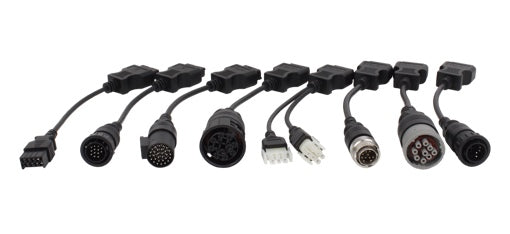
Mack and Volvo trucks frequently utilize proprietary communication pins that require specialized diagnostic cables for full system access. While a standard 9-pin connector might provide basic engine data, you'll need the correct 8-pin or specialized OBD-II cable to perform SCR resets and calibrations. Jaltest kits are specifically designed to include these connectors so you aren't locked out of dealer-level functions on these specific brands.
Diesel Mechanic Tool Financing: A Strategic Guide to Diagnostic Equipment Investment

Diesel Mechanic Tool Financing: A Strategic Guide to Diagnostic Equipment Investment

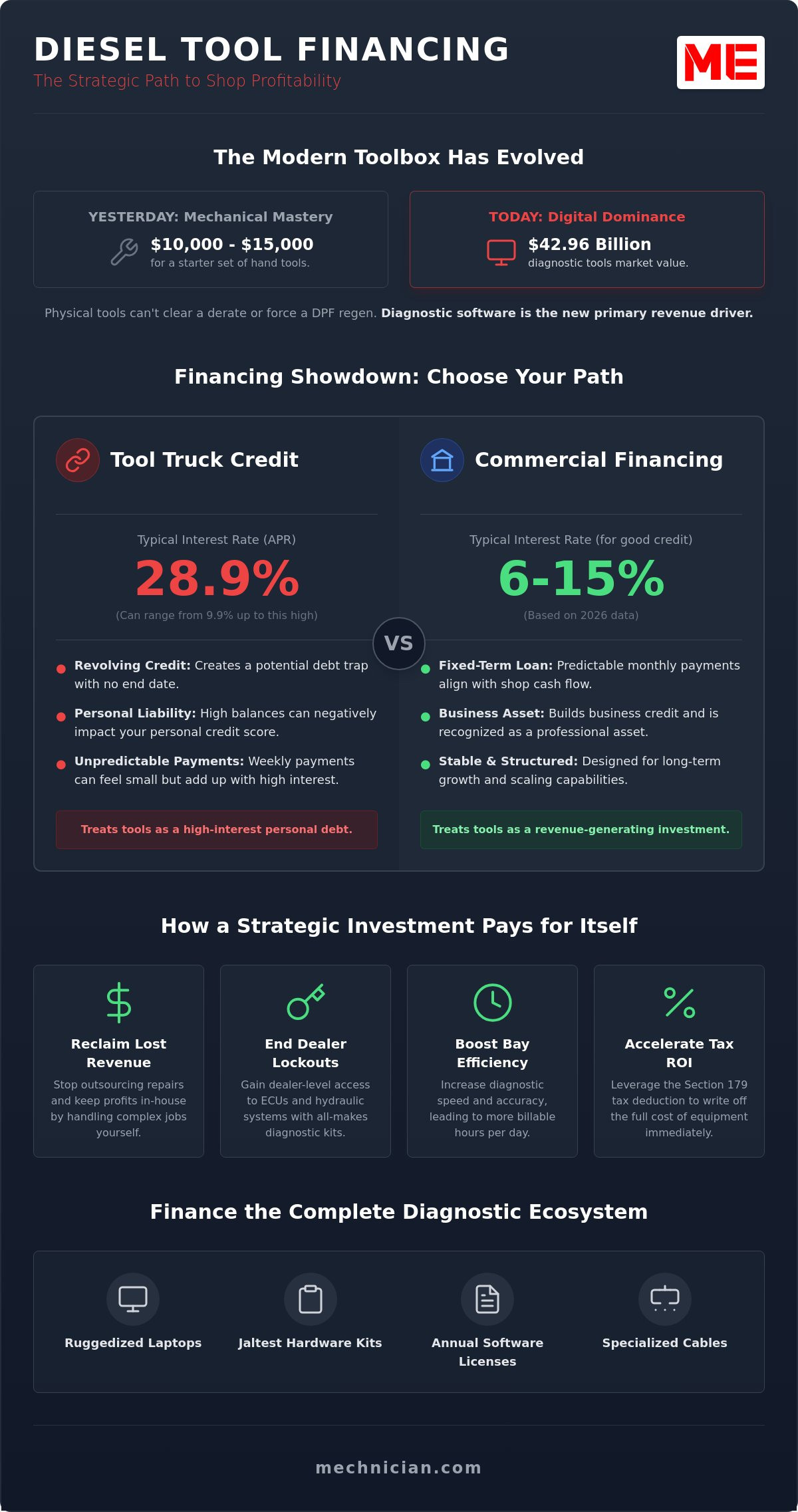
The most expensive tool in your bay isn't the one you've already paid for; it's the one you haven't bought yet because of dealer lockouts and proprietary software barriers. While traditional tool truck credit often carries interest rates as high as 28.9%, treating your diagnostic suite as a strategic asset rather than a personal debt changes the math entirely. Smart diesel mechanic tool financing allows you to bypass the massive upfront costs of ruggedized laptops and software licenses, turning a heavy capital expenditure into a manageable monthly operating cost.

It's frustrating to watch billable hours vanish because you lack dealer-level access to a specific ECU or hydraulic system. You understand that diagnostic speed is the foundation of shop efficiency, yet the high entry price of all-makes systems like Jaltest kits can feel like a barrier to growth. Discover how to leverage specialized financing to acquire dealer-level diagnostic technology and maximize your shop’s revenue potential. We'll explore how to lower your monthly overhead through commercial lending and use the Section 179 tax deduction to accelerate your return on investment.

Key Takeaways

  • Learn why fixed-term commercial equipment financing offers superior stability and lower interest rates compared to traditional revolving tool truck credit.
  • Discover how to reclaim lost revenue by investing in all-makes diagnostic kits that eliminate the high cost of dealer lockouts and outsourced repairs.
  • Understand the specific eligibility and credit requirements for diesel mechanic tool financing to ensure your shop qualifies for the latest 2026 technology.
  • See how a strategic investment in Jaltest hardware and software licenses can generate significant ROI by increasing bay efficiency and billable hours.
  • Explore flexible options for financing a complete diagnostic ecosystem, including ruggedized laptops, specialized cables, and annual software renewals.

In the current industrial landscape, the definition of a complete toolkit has undergone a fundamental transformation. For years, diesel mechanic tool financing focused almost exclusively on physical assets like impact wrenches, torque multipliers, and heavy-duty lift equipment. As of July 2026, the market has shifted. Modern heavy-duty vehicles operate on complex interconnected subsystems and dozens of Electronic Control Units (ECUs), making diagnostic software the primary revenue driver for any independent shop. Financing is no longer just a way to fill a cabinet; it's a strategic bridge to dealer-level repair capabilities that were previously out of reach for smaller operations.

The Evolution of the Diesel Technician’s Toolbox

The transition from mechanical troubleshooting to digital interfacing is complete. While a starter set of hand tools still costs between $10,000 and $15,000 according to 2025 estimates, these physical tools cannot clear a derate or force a DPF regeneration. Diagnostic kits have become the highest-priority investment because they dictate which jobs a shop can actually accept. With the diagnostic scan tools market valued at approximately $42.96 billion this year, the pressure to maintain all-makes coverage across commercial vehicles, agricultural machinery, and off-highway equipment is intense. Financing allows shops to acquire this coverage without depleting the cash reserves needed for daily operations.

Why Traditional Credit Often Fails Diesel Techs

Standard consumer credit products are rarely designed for the unique lifecycle of professional diagnostic equipment. Many technicians rely on personal credit cards or high-interest tool truck lines, but these options often carry heavy burdens. Research indicates that some tool truck credit rates can reach as high as 28.9% in the US, while representative APRs in other regions sit around 16.04%. These rates are particularly punishing when applied to software-heavy kits that require annual license renewals.

Industry-specific commercial lending offers a more logical structure for the following reasons:

  • Fixed Terms: Unlike revolving credit, commercial loans provide predictable monthly payments that align with the shop's cash flow.
  • Asset Recognition: Specialized lenders understand that a Jaltest CV Kit or a ruggedized diagnostic laptop is a professional asset with a measurable return on investment.
  • Full Ecosystem Coverage: Financing can cover the hardware, specialized diagnostic cables, and the initial Jaltest Software Annual License simultaneously.

Relying on the wrong type of credit creates a debt trap that limits a shop's ability to upgrade when new software versions or hardware standards emerge. Choosing professional diesel mechanic tool financing ensures that the technology remains an asset that generates billable hours rather than a liability that drains profits.

Commercial Financing vs. Tool Truck Credit: A Comparison

Choosing the right vehicle for diesel mechanic tool financing is as critical as choosing the diagnostic software itself. Many technicians default to the familiar tool truck credit model, yet this revolving line of credit is often ill-suited for high-value diagnostic ecosystems. While a tool truck account works for a single hand tool, it becomes a significant financial burden when applied to professional grade diagnostic suites. Commercial equipment financing offers a structured alternative that treats diagnostic tools as a business investment rather than a personal expense.

The "Tool Truck" Debt Trap

Revolving credit lines from mobile distributors often carry high interest rates that can range from 9.9% to 28.9%. These programs prioritize weekly payment cycles, which can create a misleading sense of affordability. For a technician, the psychological pressure of a weekly visit can lead to payment focused buying rather than ROI focused investing. Because these are often personal credit lines, high utilization can negatively impact your personal credit score, making it harder to secure home or auto loans later. This model lacks the long term stability needed for a shop looking to scale its diagnostic capabilities.

Advantages of Commercial Equipment Loans

Commercial equipment financing provides a more disciplined approach to growth. For borrowers with strong credit, rates in 2026 typically sit between 6% and 15% from traditional banks. These are fixed term loans with predictable monthly payments, allowing for precise cash flow forecasting. One of the primary benefits is the ability to bundle the entire ecosystem into a single agreement. You can include the Jaltest OHW Kit, specialized diagnostic cables, and even your initial Jaltest training into one manageable payment plan. This ensures your team is ready to use the equipment immediately without additional out of pocket costs.

The tax implications also favor the commercial route. Under Section 179, businesses in 2026 may be able to expense up to $1,160,000 of qualifying equipment in the year of purchase. This allows you to deduct the full cost of your diagnostic suite from your gross income, significantly lowering the effective cost of the investment. By keeping these assets on a business credit profile, you protect your personal financial health while building a professional credit history for your shop. If you are ready to move beyond the limitations of revolving credit, you can explore structured financing options for your next diagnostic kit.

Calculating ROI: How Diagnostic Tools Pay for Their Own Financing

The primary hurdle for many shop owners is viewing advanced equipment as a sunk cost. However, professional diesel mechanic tool financing shifts the perspective toward asset utilization and long term stability. When you calculate the Return on Investment (ROI), the focus moves from the monthly payment to the revenue generated by each diagnostic session. Every time a vehicle is towed to a dealer for a simple fault code clearance or a DPF regeneration, your shop loses both the service fee and the potential labor hours. By keeping these tasks in-house, independent shops can capture a growth opportunity estimated at 40% simply by eliminating the "dealer lockout" phenomenon.

Eliminating Third-Party Diagnostic Fees

Outsourcing diagnostics introduces hidden costs that extend far beyond the line item on a dealer's invoice. You have to account for towing fees, the administrative burden of coordinating with another facility, and the multi-day wait times that keep a bay occupied with a non-performing vehicle. Industry data suggests that a single dealer diagnostic hookup can cost between $150 and $350 per instance, excluding labor or repairs. Performing your own calibrations and parameter changes means these funds stay within your business. In many cases, performing just two or three advanced diagnostic procedures per month generates enough revenue to cover the entire cost of the financing installment.

Increasing Shop Throughput with Jaltest

Efficiency is the only way to scale a repair business. Using a Jaltest CV or OHW kit allows your technicians to identify fault codes across multiple brands using a single interface, which drastically reduces the time spent switching between OEM tools. When a technician encounters a complex system error, they can leverage Jaltest technical support to resolve the issue without second-guessing the data. This speed translates directly into higher shop throughput.

By reducing the time spent on each diagnostic phase, you increase the number of billable hours your team can generate each week. A shop that previously handled five major diagnostic jobs a week might find they can now manage seven or eight with the same headcount. This increased capacity is what makes diesel mechanic tool financing a strategic move; the equipment effectively pays for itself by unlocking revenue streams that were previously blocked by technical limitations.

Diesel mechanic tool financing

Qualifying for Financing: Requirements for Technicians and Shops

Securing diesel mechanic tool financing requires a methodical approach similar to troubleshooting a complex hydraulic system. Lenders in the industrial sector prioritize stability and the revenue-generating potential of the asset over simple consumer credit metrics. While traditional banks might look for a credit score above 700, many equipment-backed lenders offer approvals for scores as low as 600. This is because the diagnostic kit itself serves as collateral, reducing the lender's risk. You'll generally need to provide three to six months of bank statements and a professional equipment quote to begin the process.

The distinction between time-in-business and individual experience is a critical factor. Established shops with over two years of operation often qualify for the lowest interest rates, which typically range from 6% to 15% for strong borrowers in 2026. However, individual technicians with a documented work history can still access competitive financing through programs that recognize the high demand for skilled diagnostic labor. If your credit is less than perfect, providing a larger down payment or showing a consistent history of shop revenue can help bridge the gap and secure an approval.

Preparing Your Financing Application

Lenders prefer to finance complete, functional solutions rather than piecemeal components. When you request a quote for a Jaltest MHE or AGV kit, ensure it includes all necessary peripherals. Including a ruggedized diagnostic laptop in your financing package demonstrates to the lender that the equipment is ready for immediate field use. This "turnkey" approach makes the loan more attractive because it guarantees the tool can start generating billable hours the moment it arrives at your shop. A clear, itemized quote that includes the Jaltest Software Annual License shows professional foresight and a plan for long term sustainability.

Financing for New Shops and Independent Contractors

Starting a new LLC shouldn't prevent you from accessing dealer-level technology. Startup financing options exist specifically for newly formed businesses, though they may require a down payment of 10% to 20% to offset the lack of business credit history. In these cases, the diagnostic equipment acts as the primary security for the loan. Using the equipment as collateral allows you to preserve your personal lines of credit for other operational needs. To streamline your path to ownership, you can view the full range of diagnostic kits available for financing and select the package that fits your specific service niche.

Documentation is the final piece of the puzzle. Have your most recent tax returns and a summary of your shop’s average monthly throughput ready. When you can prove that a single DPF regeneration or a complex calibration will cover a significant portion of your monthly payment, lenders view your application as a calculated business move rather than a risky debt. This level of preparation ensures you get the best possible terms for your investment.

Mechnician’s Flexible Financing for Jaltest Diagnostic Kits

Mechnician approaches diagnostic technology with a focus on operational continuity rather than simple hardware sales. Instead of providing a generic loan for a single tool, our model for diesel mechanic tool financing encompasses the entire ecosystem required to perform dealer-level repairs. We understand that a diagnostic kit is only as effective as the software driving it and the cables connecting it to the machine. By financing the full package, including the Jaltest CV Kit, ruggedized diagnostic laptops, and specialized diagnostic cables, shops can avoid the frustration of missing components during a critical repair.

A significant advantage of this structured approach is the ability to bundle Jaltest training and technical support directly into the monthly payment. Diagnostic speed depends on the technician's proficiency with the interface. Including Jaltest University training ensures your team can utilize the full depth of the software from day one. Additionally, our financing plans can cover the initial Jaltest Software Annual License, ensuring that you have access to the three yearly updates that keep your equipment compatible with the latest vehicle models and emissions standards.

Tailored Solutions for Every Industry

Every shop has a unique service niche that dictates its equipment needs. Mechnician provides customized financing paths for specialized kits, including the Jaltest OHW (Off-Highway) Kit for construction and the Jaltest AGV Kit for agricultural machinery. Specialists in material handling can finance the Jaltest MHE Kit, while those working in the shipping sector can acquire the Jaltest Marine Kit. This flexibility allows you to build a diagnostic suite that matches your specific fleet requirements. You don't have to pay for passenger car coverage you don't use; instead, you invest in the precise modules that generate revenue in your bays.

The Mechnician Advantage: Support Beyond the Sale

The value of a diagnostic tool is maintained through consistent uptime and expert assistance. Our investment packages often include access to Jaltest technical support, providing a safety net for complex troubleshooting scenarios. This remote support functions as an external professional unit, helping your technicians navigate difficult wiring diagrams or system calibrations. Planning for the future is also a core part of our philosophy. We help shops manage the long term costs of technology by offering clear paths for financing future software renewals, ensuring your shop never faces a "digital lockout" due to an expired license.

Choosing the right partner for your equipment needs is a decision that impacts your shop's stability for years to come. Contact Mechnician to discuss your custom financing plan today. Our team will help you identify the hardware, software, and training bundle that best serves your operational goals while maintaining a manageable monthly overhead.

Securing Your Shop’s Competitive Edge

The shift toward digital diagnostics is a permanent evolution in the heavy-duty repair sector. Transitioning from high-interest revolving credit to structured diesel mechanic tool financing allows you to treat diagnostic equipment as a primary revenue driver rather than a financial burden. By securing dealer-level capabilities in-house, your shop eliminates the high cost of third-party outsourcing and significantly improves bay throughput. This strategic approach ensures that your technical infrastructure remains a stable foundation for growth.

Success in this complex landscape requires more than just hardware. It demands a partnership that provides the training and technical depth necessary to handle modern vehicle complexity. As an Authorized Jaltest Dealer, Mechnician offers a complete ecosystem including expert remote technical support and comprehensive training via Jaltest University. These resources ensure your investment remains productive and your team stays ahead of proprietary software barriers. Your shop’s growth depends on the stability and precision of your tools.

Take the next step toward reclaiming your billable hours and expanding your service range. View Jaltest Diagnostic Bundles and Financing Options to find a solution tailored to your operational needs. Secure your shop’s future with the professional support your expertise deserves.

Frequently Asked Questions

Can I finance a used diagnostic kit or just new equipment?

Commercial lenders primarily focus on new equipment because it includes a manufacturer warranty and a predictable service life. Financing used diagnostic hardware is often more complex because the software licenses may not be easily transferable or the hardware may be near obsolescence. Investing in new equipment through diesel mechanic tool financing ensures you have the latest processor speeds and interface standards required for modern ECUs.

How does financing a Jaltest kit differ from a tool truck account?

Commercial financing provides a fixed-term loan with a set end date and lower interest rates than revolving tool truck credit. While mobile distributor credit can carry interest rates as high as 28.9%, professional commercial loans for established shops in 2026 typically range from 6% to 15%. This structure allows for better long-term financial planning and protects your personal credit score by keeping the debt on a business profile.

Is the annual software license renewal fee eligible for financing?

You can bundle the initial Jaltest Software Annual License into your primary financing agreement. This allows you to spread the cost of the software across your monthly payments rather than paying a large sum upfront. For subsequent years, many shops use a small equipment line of credit to manage renewals, ensuring their diagnostic tools never face a "digital lockout" due to an expired license.

What is the typical interest rate for diesel mechanic tool financing in 2026?

Interest rates for strong borrowers in 2026 generally sit between 6% and 15% through traditional banks and specialized industrial lenders. These rates are significantly more favorable than the 16.04% representative APR often found in hire purchase programs from tool manufacturers. Your specific rate will depend on your shop's time-in-business, your credit history, and the total value of the diagnostic ecosystem you are acquiring.

Do I need a business license to qualify for commercial tool financing?

Most lenders require a valid business license or proof of a legal entity, such as an LLC, to approve a commercial loan. This documentation proves that the equipment is a professional asset intended for revenue generation. Independent contractors who don't own a shop can often qualify by providing tax returns that demonstrate a consistent history of self-employment in the heavy-duty repair industry.

Can I bundle training and technical support into my monthly tool payment?

You can include Jaltest training and remote technical support packages in your total financed amount. Lenders often prefer these bundled "turnkey" solutions because they guarantee the technician has the expertise to generate revenue with the tool immediately. Including these services ensures that your shop has the necessary professional backing to resolve complex diagnostic faults without additional out-of-pocket costs.

What happens if I want to upgrade my diagnostic laptop before the loan is paid off?

Many commercial equipment agreements allow for "mid-term" upgrades through a lease addendum or a loan restructure. This flexibility allows you to trade in your current hardware for a more powerful ruggedized diagnostic laptop while rolling the remaining balance into a new agreement. This ensures your hardware performance always matches the requirements of the latest software updates and vehicle communication protocols.

Are there tax benefits to leasing my diagnostic equipment instead of buying it?

Leasing provides substantial tax advantages, particularly through the Section 179 deduction. In 2026, qualifying businesses can expense up to $1,160,000 of equipment in the year of purchase, which applies to many lease-to-own structures. This allows you to deduct the full cost of your Jaltest CV or OHW kit from your gross income, significantly reducing the effective cost of your investment while preserving your working capital.

Heavy Equipment Diagnostic Training: The Master Guide for 2026

Heavy Equipment Diagnostic Training: The Master Guide for 2026

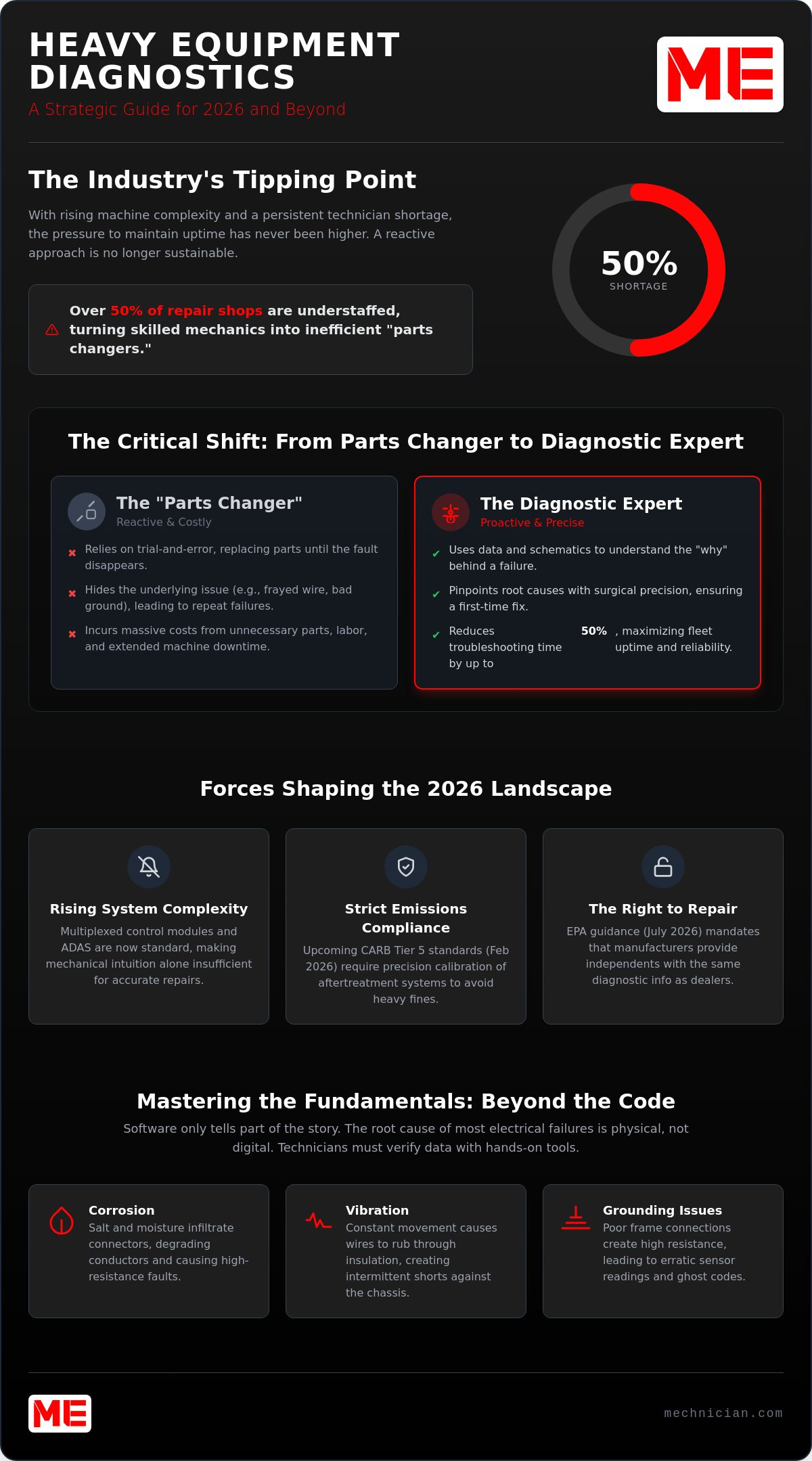
What if your maintenance team could resolve complex fault codes without waiting days for a dealer technician to arrive on-site? With over 50% of heavy-duty repair shops currently facing understaffing, the pressure to maintain uptime has never been higher. It's frustrating to watch skilled mechanics become "parts changers" simply because they lack the specific knowledge to interpret modern Tier 4 Final or Stage V emission systems. Investing in heavy equipment diagnostic training isn't just an elective choice for fleet managers. It's a strategic requirement for operational stability.

We understand that the increasing density of sensors and ECUs can feel overwhelming. This master guide for 2026 will show you how to bridge the technical skills gap, master intricate system diagnostics, and significantly reduce your reliance on outside dealers. We'll walk through the latest industry developments, including the July 2026 EPA "Right to Repair" guidance and the advanced capabilities of Jaltest version 26.1. Our goal is to help your shop operate with the precision and confidence that modern machinery demands.

Key Takeaways

  • Understand why modern heavy equipment requires a shift from reactive parts replacement to proactive, system-level analysis.
  • Learn why fundamental knowledge of electrical flow and hydraulic pressure is critical before connecting any software.
  • Discover how professional heavy equipment diagnostic training through Jaltest University enables your team to manage hundreds of brands with one interface.
  • Identify the hardware and culture shifts, including the use of ruggedized laptops, needed to maintain a high-functioning shop floor.
  • Explore how technical support and authorized partnerships help your technicians solve complex faults without dealer intervention.

Why Heavy Equipment Diagnostic Training is Essential in 2026

The heavy equipment industry has reached a tipping point where mechanical intuition alone is no longer sufficient. In 2026, machines are defined by multiplexed control modules and Advanced Driver Assistance Systems (ADAS) that require a higher level of technical literacy. Comprehensive heavy equipment diagnostic training serves as the bridge between traditional mechanical repair and modern system engineering. It represents a fundamental shift from reactive parts replacement to proactive, data-driven system analysis.

Relying on a "trial and error" approach creates a cascade of financial losses. When a technician replaces a high-pressure fuel pump only to find the fault remains, the business loses the cost of the part, the labor hours, and the potential revenue from the machine's downtime. Professional training transforms these "parts changers" into diagnostic experts who can pinpoint root causes with surgical precision. This shift is critical for maintaining fleet operational stability, especially since reports from 2025 and 2026 indicate that over 50% of repair shops are struggling with a persistent technician shortage.

Precision calibration is also a matter of compliance. With the California Air Resources Board (CARB) developing Tier 5 emissions standards as of February 2026, the margin for error in exhaust aftertreatment systems has narrowed. Accurate heavy equipment diagnostic training ensures that your team can maintain machines to these stringent requirements, preventing heavy fines and environmental non-compliance while ensuring the safety of the operator through properly calibrated ADAS sensors.

The Shift from Parts Changer to Diagnostic Expert

Throwing parts at a fault code is the most expensive way to manage a fleet. It hides the underlying issue, such as a frayed wire or a failing sensor, which will inevitably cause the new part to fail again. Developing an engineering mindset involves using technical data to understand the "why" behind a failure. Industry professionals report that utilizing integrated technical data can reduce troubleshooting time by up to 50%, allowing machines to return to the field faster and with greater reliability.

Dealer Lockouts and the Right to Repair

Independent shops often feel sidelined by proprietary software lockouts. However, the regulatory landscape changed significantly on July 1, 2026, when the EPA issued new guidance affirming that manufacturers must provide independent shops with the same diagnostic information available to branded centers. By mastering all-makes diagnostic tools, your team can reclaim revenue that was previously lost to dealer service departments. To understand how these tools fit into current requirements, refer to our Professional Vehicle Diagnostic Tool Guide for more details on industry standards.

Mastering the Core Fundamentals: Electrical and Hydraulic Systems

High-end software is a powerful asset, but it remains ineffective if the technician doesn't understand the physical medium it monitors. Professional heavy equipment diagnostic training must prioritize the physics of the machine before the logic of the code. A fault code for "low fuel pressure" might lead a technician to replace a sensor, but a manual pressure gauge might reveal a clogged primary filter or a failing lift pump. Without these fundamentals, the software is merely a digital suggestion box rather than a precision instrument.

The technician’s toolkit must move beyond the code reader. While a laptop provides the data, multimeters and pressure gauges identify the physical reality. Interpreting complex wiring harnesses and hydraulic circuits requires more than just looking at a screen; it requires the ability to read and understand schematics. In the heavy-duty sector, most electrical failures aren't caused by computer glitches. They're caused by physical stressors:

  • Corrosion: Salt and moisture infiltrating connectors and eating away at copper conductors.
  • Vibration: Constant movement causing wires to rub through insulation against the chassis or brackets.
  • Grounding Issues: Poor connections at the frame that create high resistance and erratic sensor readings.

Developing a diagnostic mindset means using these tools to verify what the software reports. If the software shows five volts at a sensor but the multimeter shows three, you've identified a wiring issue, not a component failure. This level of precision saves hours of unnecessary labor. To ensure your shop is equipped with tools that match this level of expertise, consider exploring the professional diagnostic kits and support available for modern fleets.

Electrical Theory for Heavy-Duty Technicians

Ohm’s Law is the foundation for troubleshooting sensors and actuators. Technicians need to be able to calculate expected values to identify open circuits, short circuits, or high resistance. When dealing with J1939 data links, a multimeter is essential for performing voltage drops and continuity tests. This ensures the communication highway is functional before an expensive ECU is condemned. Accuracy here prevents the costly mistake of replacing healthy modules.

Hydraulic Diagnostics and System Integration

Modern hydraulics rely on the seamless integration of electronic control valves and mechanical outputs. Diagnosing a solenoid failure often involves software-driven activation tests, but the technician must verify the actual hydraulic response at the cylinder or motor. Safety protocols are critical during these routines. High-pressure systems can be lethal if handled incorrectly. Training must emphasize pressure relief procedures and the correct use of test ports to ensure the diagnostic process remains safe and controlled.

Jaltest University: A Comprehensive Software Training Ecosystem

Modern diagnostics requires more than just a tool; it requires a structured learning environment that evolves alongside the machinery. Jaltest University represents this shift by providing a dynamic training ecosystem rather than a static set of instructions. With the release of version 26.1 in March 2026, the platform has integrated advanced web-based workshop management and expanded vehicle coverage. This ensures that heavy equipment diagnostic training stays relevant as manufacturers release new ECU configurations and complex subsystems. By consolidating diagnostic capabilities into a single interface, technicians can apply a consistent methodology across diverse brands like Caterpillar, Komatsu, or John Deere, reducing the cognitive load on your team.

The versatility of an all-makes platform is essential for shops managing mixed fleets. Instead of learning ten different proprietary programs, your staff masters one environment. This mastery extends to advanced calibrations that were once the sole domain of dealers. Training modules cover critical procedures such as DPF regenerations, injector coding, and Variable Geometry Turbocharger (VGT) actuations. These are high-stakes tasks where precision is non-negotiable. Staying current with these capabilities requires a Jaltest Software Annual License, which provides the regular updates needed to interface with the latest manufacturer releases and emissions protocols.

Specialized Training for Off-Highway and Agricultural Equipment

The Jaltest OHW (Off-Highway) Kit requires specific procedural knowledge to navigate the unique architectures of construction machinery. Technicians learn how to perform hydraulic calibrations and engine health checks on excavators, loaders, and graders. Similarly, mastering the Jaltest AGV (Agricultural Equipment) Kit involves understanding the seasonal demands of tractors and combines. Precision here ensures that a machine is ready for the field when it matters most. For those also managing transport fleets, our Jaltest CV Kit Guide provides a detailed look at all-makes truck diagnostics in the current market.

The Role of Technical Data and Wiring Diagrams

Software is most effective when it provides a clear path to resolution. The Jaltest interface includes integrated troubleshooting guides that lead the technician through a step-by-step repair path based on specific fault codes. This includes component locations and technical specifications that eliminate guesswork. In warehouse environments, maximizing the value of the Jaltest MHE (Material Handling Equipment) Kit means being able to quickly identify electrical faults in forklifts or telehandlers. Access to interactive wiring diagrams allows your team to trace circuits with confidence, ensuring that every repair is grounded in verified technical data.

Heavy equipment diagnostic training

Building a Diagnostic-First Culture in Your Maintenance Team

Transforming a shop's performance requires more than just a software purchase. It demands a cultural shift where diagnostics are prioritized over parts replacement. This process starts with a systematic assessment of your current staff to identify specific knowledge gaps. Some technicians might have decades of mechanical experience but struggle with multiplexed circuits. Others may be comfortable with computers but lack a deep understanding of hydraulic pressures. Once you've mapped these skills, heavy equipment diagnostic training becomes a targeted roadmap for growth rather than a generic classroom exercise.

Implementing a "diagnostic-first" approach means creating a low-stakes environment for learning. Fleet managers should schedule dedicated training hours where technicians can explore software features on machines that aren't currently facing an emergency deadline. This practice allows them to navigate technical data and wiring diagrams without the pressure of an active machine down situation. Incentivizing this progress is equally important. Rewarding technicians who complete Jaltest University modules or achieve specific certifications turns professional development into a valued career milestone. To support this transition, you can explore our range of ruggedized diagnostic laptops and technical training solutions designed for professional environments.

Remote Technical Support as Continuous Education

Technical support shouldn't be viewed as a one-time rescue for a difficult fault. Instead, it functions as a live classroom experience. When your team uses Jaltest technical support to resolve complex "ghost codes" or intermittent faults, they're participating in a guided repair path. This interaction builds long-term competence and breaks the cycle of dealer reliance. Over time, these guided sessions empower your technicians to handle similar issues independently, turning every challenging repair into a teaching tool for the entire shop.

Selecting the Right Hardware for Training

The shop floor is a hostile environment for standard consumer electronics. Extreme temperatures, dust, and physical impacts will quickly disable a standard laptop, halting your heavy equipment diagnostic training efforts. Ruggedized diagnostic laptops are engineered to survive these conditions. They ensure that your team has reliable access to the Jaltest software annual license updates and technical specifications whenever a machine enters the bay. Investing in hardware that matches the durability of your heavy equipment is a strategic decision that prevents unnecessary downtime and hardware replacement costs.

The Mechnician Advantage: Beyond the Training Course

Completing a certification is only the first step toward diagnostic independence. True operational stability comes from a long term partnership with experts who understand the realities of the shop floor. Mechnician serves as your authorized partner for Jaltest solutions; providing the technical upskilling and hardware support necessary to maintain a modern fleet. We don't just deliver a kit and leave; we provide a national network of specialists capable of offering remote guidance and on-site assistance when your team encounters a particularly stubborn fault. This commitment to your fleet's uptime ensures that your investment in heavy equipment diagnostic training yields a measurable return in reduced dealer fees and shorter repair cycles.

Financial accessibility is a key part of our solution. We offer flexible financing options for diagnostic kits and training enrollment fees, allowing maintenance departments to modernize their toolsets without immediate capital strain. This professional approach treats technical education as a strategic asset for future stability rather than a one-time expense. By aligning your team with Mechnician and Cojali, you're integrating a dedicated technical unit into your organization that takes responsibility for the continuous functionality of your diagnostic capabilities.

Total Lifecycle Support for Your Diagnostic Tools

Maintaining the edge in diagnostics requires keeping your tools as current as the machinery they service. This involves managing Jaltest Software Annual License renewals to ensure compatibility with the latest ECU releases and emissions standards. Our support extends to providing Specialized Diagnostic Cables for niche or legacy equipment, ensuring you never lose coverage on older assets. Our technical support team is always available to help your technicians maximize tool utilization, helping them navigate new software features as they are released.

Next Steps: Reclaiming Control of Your Repairs

Reclaiming control over your maintenance schedule starts with a customized training plan tailored to your department's specific needs. Whether you're managing a small construction fleet or a large agricultural operation, the combination of Jaltest versatility and Mechnician expertise provides a clear path to self-sufficiency. The long term benefits of this partnership include a more confident workforce and a significant reduction in machine downtime. You can contact Mechnician to discuss your heavy equipment diagnostic training needs and begin the transition toward a more efficient, diagnostic-first maintenance culture.

Securing Your Fleet's Operational Future

The heavy equipment landscape in 2026 requires a precise blend of mechanical intuition and digital literacy. By integrating fundamental system theory with advanced software capabilities, your team can finally break the cycle of expensive dealer reliance. We've explored how a diagnostic-first culture, supported by ruggedized hardware and specialized training, transforms your shop into a high-efficiency unit. This transition ensures that your equipment stays in the field rather than waiting in a service bay for weeks at a time.

Professional heavy equipment diagnostic training is a necessary investment in your fleet's long-term stability. As an Authorized Jaltest Dealer, Mechnician provides the tools and knowledge your technicians need to succeed. You'll gain direct access to Jaltest University and our expert remote technical support to ensure your team solves even the most complex faults with confidence. This partnership provides the technical backbone your organization needs to thrive in an increasingly complex industry.

Empower your team with Jaltest Training and Diagnostic Kits at Mechnician.com and reclaim control over your repair timelines today. Your journey toward technical self-sufficiency is a strategic decision that builds a more resilient future for your business.

Frequently Asked Questions

How long does it take to become proficient in heavy equipment diagnostics?

Proficiency in heavy equipment diagnostics typically takes between six and twelve months of consistent hands-on experience and structured study. While basic fault code reading can be learned quickly, mastering complex system analysis and bi-directional testing requires ongoing engagement with modern software. Technicians who commit to regular modules often see a significant improvement in their troubleshooting speed within the first year.

Can I learn to use Jaltest software online, or is in-person training required?

You can learn to use Jaltest software through online modules provided by Jaltest University, which offers a flexible way to master the interface. These web-based courses allow technicians to progress at their own pace from any location. While in-person workshops can provide valuable tactile experience, the digital platform is designed to be a comprehensive standalone resource for software literacy.

What is the difference between a code reader and a professional diagnostic kit?

A professional diagnostic kit offers bi-directional control and deep system access that a simple code reader cannot match. While a code reader only identifies a fault, a professional kit allows you to perform DPF regenerations, calibrate actuators, and access integrated wiring diagrams. This level of heavy equipment diagnostic training ensures your team can actually repair the machine rather than just identifying the symptom.

What happens if my technicians encounter a fault they cannot solve after training?

Technicians who encounter an unsolvable fault can utilize expert remote technical support to guide them through the repair path. This real-time assistance acts as a safety net, ensuring that complex "ghost codes" or intermittent failures don't result in machine downtime. This service functions as an extension of your team, providing the confidence needed to tackle advanced electronic issues.

Is Jaltest University included with the purchase of a diagnostic kit?

Access to Jaltest University is typically included with the purchase of a diagnostic kit and the maintenance of an active software license. This ensures that your team has the educational resources needed to utilize the tool's full potential from day one. It serves as a centralized hub for learning the specific nuances of OHW, AGV, and CV modules.

Do I need a separate training course for different brands like Caterpillar or John Deere?

No, you don't need separate training courses for different brands because Jaltest utilizes a unified interface for hundreds of manufacturers. Once a technician learns the software logic, they can apply the same diagnostic process to Caterpillar, John Deere, or Komatsu machinery. This all-makes versatility is a primary advantage of professional heavy equipment diagnostic training, as it simplifies the learning curve for mixed fleets.

How much does heavy equipment diagnostic training typically cost for a team?

The cost of diagnostic training varies based on the depth of the program and the number of technicians involved. Industry-standard workshops for specific systems like hydraulics or electrical troubleshooting often range from $450 to $475 per person at technical universities. For a full maintenance department, a customized plan involving software-integrated modules is often the most cost-effective way to achieve team-wide proficiency.

Can training help reduce my fleet’s annual maintenance budget?

Training helps reduce your fleet’s annual maintenance budget by significantly lowering the frequency of dealer service calls and reducing machine downtime. When technicians can identify root causes accurately, you avoid the "parts changer" mentality that leads to unnecessary component costs. Over time, the ability to perform in-house calibrations and regenerations provides a measurable return on investment.

Guide professionnel de l'outil de diagnostic automobile : normes industrielles 2026

Guide professionnel de l'outil de diagnostic automobile : normes industrielles 2026

Chaque heure où votre camion lourd reste immobilisé dans une baie d’atelier en Ontario ou en Alberta coûte à votre exploitation en moyenne 1 200 $ CA de revenus perdus et de frais de service. Vous savez déjà que dépendre des techniciens OEM pour de simples réinitialisations de capteurs crée un goulot d’étranglement qui grève votre budget de maintenance. C’est frustrant lorsqu’un lecteur de codes générique identifie une panne mais ne dispose pas de la commande bidirectionnelle nécessaire pour lancer une régénération du FAP ou calibrer un capteur d’angle de braquage. Un seul retard de diagnostic peut se répercuter sur toute votre chaîne logistique, transformant un simple dysfonctionnement de capteur en panne opérationnelle de plusieurs jours.

Ce guide fournit la feuille de route technique pour choisir un outil de diagnostic pour véhicule professionnel conforme aux normes industrielles de 2026. Vous apprendrez à contourner les intermédiaires des concessionnaires, à réduire vos dépenses de service externe jusqu’à 40 %, et à obtenir une capacité de réparation indépendante complète sur l’ensemble de votre flotte multimarque. Nous examinerons les exigences matérielles spécifiques et les protocoles logiciels nécessaires pour maintenir 98 % de disponibilité de la flotte sans interférence propriétaire des OEM.

Points clés

  • Faites la différence entre les lecteurs de codes de base et les systèmes à spectre complet afin de garantir que votre atelier répond aux exigences techniques des protocoles industriels de 2026.
  • Maîtrisez des fonctions avancées comme les commandes bidirectionnelles et les calibrations système pour effectuer des réglages de précision sur les actionneurs VGT et les vannes hydrauliques.
  • Calculez le retour sur investissement important de l’indépendance vis-à-vis des concessionnaires en éliminant les tarifs horaires élevés et les coûts de remorquage de plus de 1 000 $ CA qui pèsent sur les marges des flottes canadiennes.
  • Choisissez le outil de diagnostic pour véhicule optimal adapté à votre secteur spécifique, du transport commercial aux machines de construction spécialisées hors route.
  • Tirez parti d’un support technique professionnel et d’un diagnostic à distance pour minimiser les temps d’arrêt et considérer la maintenance comme un investissement stratégique dans la productivité.

Qu’est-ce qui définit un outil de diagnostic pour véhicule professionnel en 2026 ?

D’ici 2026, la complexité de l’électronique automobile est arrivée à un niveau où une simple approche plug-and-play ne suffit plus pour la maintenance industrielle. Les flottes modernes au Canada s’appuient désormais sur des architectures E/E zonales qui exigent davantage qu’une simple connexion ; elles nécessitent une véritable prise de contact avec la passerelle centrale du véhicule. Un outil de diagnostic pour véhicule professionnel représente un investissement stratégique dans la disponibilité. Sur le marché actuel, un appareil haut de gamme coûte généralement entre 3 800 $ CA et 9 500 $ CA, ce qui reflète son rôle d’équipement industriel critique. Ces outils doivent gérer des accès sécurisés aux données et des modules chiffrés qui n’existaient pas il y a dix ans. La précision dans la détection des pannes est la base du maintien de la sécurité opérationnelle.

Lecteurs de codes vs scanners de diagnostic

Il est essentiel de distinguer ces deux catégories pour l’efficacité de l’atelier. Les lecteurs de codes de base fonctionnent en mode « lecture seule ». Ils extraient les DTC génériques (codes d’anomalie de diagnostic) liés aux diagnostics embarqués (OBD), principalement pour la surveillance des émissions. Ils ne peuvent pas effectuer de calibrations ni de tests bidirectionnels. À l’inverse, un scanner de diagnostic professionnel est un instrument « lecture-écriture ». Il permet aux techniciens de commander des composants, comme l’activation cyclique d’une pompe ABS ou le lancement forcé d’une régénération du FAP. Les outils OBDII génériques échouent souvent dans les environnements lourds parce qu’ils ne disposent pas des protocoles propriétaires du fabricant nécessaires pour 85 % des pannes profondes trouvées dans les camions de vocation ou les machines spécialisées. Utiliser le mauvais outil entraîne des diagnostics erronés et des temps d’arrêt prolongés.

L’évolution de la technologie VCI

L’interface de communication véhicule (VCI) est passée d’un simple pont à un puissant dispositif de calcul en périphérie. Les VCI modernes utilisent le CAN FD (Flexible Data-rate) et le DoIP (Diagnostics over IP) pour gérer des vitesses de transfert de données allant jusqu’à 100 Mbps. Cette vitesse est nécessaire car les véhicules de l’année-modèle 2026 traitent souvent 40 Go de données lors d’un scan complet du système. La VCI agit comme traducteur entre les données brutes du bus CAN du véhicule et le logiciel utilisateur. Le Bluetooth 5.2 haut débit et les connexions Wi-Fi bi-bande ont remplacé les câbles physiques contraignants d’autrefois. Cela permet aux techniciens de surveiller les données en direct à 30 mètres de distance, ce qui est essentiel pour la sécurité lors des tests de machines lourdes. Cette technologie élimine la latence qui causait auparavant des pertes de signal pendant les procédures critiques de reprogrammation de l’ECU.

Les normes de 2026 exigent un outil de diagnostic pour véhicule capable de gérer simultanément plusieurs protocoles de communication. Un appareil professionnel doit communiquer avec le groupe motopropulseur sur un canal tout en interrogeant le module ADAS (systèmes avancés d’aide à la conduite) sur un autre. Cette capacité multi-flux est une exigence des certifications de sécurité modernes dans le secteur du transport canadien. La fiabilité est ici la priorité ; un technicien ne peut pas se permettre un délai d’attente de communication lors de la configuration d’un capteur d’angle de braquage ou d’un contrôleur de freinage.

La robustesse est un autre facteur qui distingue l’équipement professionnel de l’électronique grand public. Si une tablette grand public à 600 $ CA peut sembler rentable, elle ne dispose pas de la gestion thermique nécessaire pour des quarts de 10 heures dans un atelier canadien non climatisé. Pour vous assurer que les systèmes de climatisation de votre installation sont à la hauteur, vous pouvez visiter Zee Jay Mechanical pour une assistance spécialisée en CVC. Les outils professionnels affichent des indices IP65 ou IP67, garantissant une protection contre l’huile, le liquide de frein et les chutes de 1,5 mètre sur le béton. Les tablettes grand public réduisent souvent la cadence de leurs processeurs lorsque les températures internes atteignent 35 °C, ce qui provoque des plantages logiciels pendant les scans approfondis. Dans les environnements industriels, une défaillance matérielle se traduit directement par un temps d’arrêt des machines. Investir dans un équipement renforcé est une décision calculée pour assurer une durabilité à long terme et des performances constantes sur le terrain.

Fonctions avancées : aller au-delà de l’interprétation des codes d’anomalie

La lecture d’un code d’anomalie ne représente que 15 % du processus de diagnostic. Un outil de diagnostic pour véhicule professionnel agit comme un pont pour une communication bidirectionnelle. Il n’écoute pas seulement ; il s’exprime. Cette capacité permet aux techniciens de valider les réparations sans remplacer des pièces par essai-erreur, ce qui pèse souvent sur la productivité de l’atelier. Lorsqu’un outil peut commander le véhicule, le processus de diagnostic passe de la supposition à la vérification empirique.

Bien que cet article se concentre sur le diagnostic des flottes industrielles, le besoin de précision technique est le même dans le monde de la performance automobile. Pour les lecteurs intéressés par l’entretien et les améliorations de véhicules haute performance, vous pouvez découvrir Oztrack Performance Tuning & Engines pour consulter des guides techniques spécialisés pour les modèles orientés performance.

Commande bidirectionnelle : la norme professionnelle

Les tests bidirectionnels font passer le technicien du rôle d’observateur à celui d’opérateur. Vous pouvez déclencher l’activation d’une pompe à carburant ou commander directement une vitesse spécifique du ventilateur de refroidissement depuis l’interface. Ces tests isolent les défaillances mécaniques des erreurs électroniques de capteur. Si l’outil commande un ventilateur à 100 % et qu’il reste immobile, vous avez confirmé un problème de moteur ou de câblage plutôt qu’un capteur de température défectueux. Les outils Jaltest intègrent des protocoles de sécurité qui surveillent les seuils de température et de pression du moteur. Ces garde-fous empêchent d’endommager les composants en interrompant automatiquement un test si les paramètres dépassent les limites de sécurité pendant les simulations à forte charge.

Au-delà des tests, l’outil gère des calibrations système critiques. Le réglage des actionneurs du turbocompresseur à géométrie variable (VGT) ou le recalibrage des capteurs d’angle de braquage exigent une saisie de données précise. Pour les propriétaires d’équipements lourds au Canada, le maintien en bon état du filtre à particules diesel (DPF) et de la réduction catalytique sélective (SCR) est obligatoire afin d’éviter le « mode dégradé » et des pertes de 2 000 $ CA par jour liées aux temps d’arrêt. Les régénérations forcées et les réinitialisations du niveau de suie sont des procédures standard pour tout outil de diagnostic pour véhicule prêt pour une flotte. Ces tâches garantissent que le système de post-traitement des gaz d’échappement fonctionne dans les paramètres environnementaux stricts exigés sur les routes canadiennes.

Les protocoles de diagnostic modernes suivent des normes de diagnostic SAE International strictes afin d’assurer des échanges de données sécurisés. Ces normes évoluent pour intégrer les modèles de véhicules 2026, garantissant que les passerelles ECU chiffrées n’empêchent pas les ateliers indépendants d’effectuer les réparations nécessaires. Le respect de ces normes signifie que l’outil peut communiquer avec les architectures de réseau de bord (bus CAN) les plus récentes sans risque de corruption des données ou de verrouillage des modules.

Programmation de l’ECU et ajustements des paramètres

Les gestionnaires de flotte doivent souvent modifier les limiteurs de vitesse ou les réglages de prise de force (PTO) pour répondre à des exigences opérationnelles spécifiques. Un accès professionnel est requis pour ces changements. Le « Mode Expert » de Jaltest permet aux techniciens d’effectuer ces calibrations avancées sans attendre les mots de passe de niveau concessionnaire. Cette fonction permet d’économiser en moyenne 4,5 heures par intervention en supprimant le besoin d’une autorisation tierce. Les mises à jour techniques dans le cloud garantissent que votre logiciel reste à jour avec les derniers modèles 2026, fournissant en temps réel les schémas de câblage et les spécifications de couple à mesure que les fabricants publient leurs bulletins techniques.

Les schémas de câblage interactifs changent la façon dont les réparations physiques sont réalisées. Au lieu de parcourir des manuels de 500 pages, l’outil met en évidence le circuit précis lié à la panne. Cette précision réduit le temps de diagnostic de 35 % sur les problèmes électriques complexes. Si votre configuration actuelle ne dispose pas de ces fonctions, il est probablement temps de évaluer votre matériel de diagnostic afin de garantir la fiabilité à long terme de l’équipement. Disposer des bonnes données au moment de la réparation fait la différence entre une correction en 30 minutes et un retard de trois jours.

Le ROI de l’indépendance vis-à-vis des concessionnaires : analyser l’écart de coûts

Posséder un outil de diagnostic pour véhicule professionnel n’est pas qu’une question de commodité ; c’est une stratégie financière calculée. Au Canada, les tarifs de main-d’œuvre des concessionnaires pour les équipements lourds dépassent souvent 220 $ CA de l’heure. Si l’on ajoute le coût d’un remorquage lourd, qui s’élève en moyenne à 850 $ CA pour une excavatrice de taille moyenne, une seule panne peut coûter 3 000 $ CA avant même que les pièces ne soient commandées. Votre vraie perte est le coût d’opportunité. Une machine à l’arrêt peut coûter à une entreprise de construction 4 500 $ CA de revenus par jour. En réalisant les diagnostics sur site, vous éliminez le temps de transport et l’attente de triage de 48 heures courante dans les grands concessionnaires.

Investir dans une plateforme multimarque unique comme Jaltest remplace le besoin de 7 ou 8 ordinateurs portables OEM distincts. Chaque licence OEM peut coûter 2 500 $ CA par an. Regrouper tout cela dans une seule interface réduit l’encombrement matériel et le temps de formation. Beaucoup de techniciens s’inquiètent des « verrouillages concessionnaire », mais c’est en grande partie un mythe. Les outils modernes respectent la norme UDS ISO 14229-2, qui garantit une communication unifiée entre différentes unités de commande électroniques. Cette normalisation permet aux outils tiers d’effectuer 95 % des tâches de niveau concessionnaire, y compris les changements de paramètres et les calibrations de composants.

Le calcul est simple. Prenons une régénération forcée du FAP. Un concessionnaire facture généralement 600 $ CA pour ce service, plus le coût d’acheminement de la machine à son atelier. Si votre technicien effectue cette opération sur le terrain à l’aide de votre propre outil de diagnostic pour véhicule, vous avez économisé environ 1 400 $ CA de dépenses totales. Pour un kit de diagnostic à 7 000 $ CA, cette seule intervention récupère 20 % de votre investissement initial. La fiabilité sur le terrain signifie que vous ne dépendez pas du planning d’un concessionnaire.

Briser le monopole des OEM

Le mouvement du droit à la réparation, soutenu par une législation canadienne comme le projet de loi C-244, a modifié l’équilibre des pouvoirs. Les fabricants ne peuvent plus légalement garder sous clé les données de réparation de base. Des systèmes comme Jaltest intègrent les protocoles Caterpillar, John Deere et Volvo dans une interface unique et cohérente. Vous obtenez les mêmes schémas de câblage et les mêmes spécifications de couple que ceux utilisés par le concessionnaire. Ce n’est pas seulement aussi bien que l’outil du concessionnaire ; c’est souvent plus rapide parce qu’il n’a pas besoin de pings VPN constants vers un serveur d’entreprise. Vous possédez les données. Vous contrôlez le calendrier.

La valeur des licences logicielles annuelles

Un scanner de diagnostic est un produit vivant. Pour 2026, les modules Jaltest OHW sont prévus pour trois grandes versions logicielles, garantissant la compatibilité avec les tout derniers contrôleurs moteur Tier 4 Final et Stage V. Votre frais de licence annuelle n’est pas une taxe. C’est un abonnement à une immense base de données d’ingénierie. Ce montant couvre :

  • L’accès aux modules de formation Jaltest University pour les nouveaux techniciens.
  • Une assistance à distance en temps réel par des mécaniciens experts spécialisés.
  • Des guides de dépannage mis à jour pour plus de 3 000 modèles d’équipements.
  • Une nouvelle couverture ECU à mesure que les fabricants mettent à jour leur micrologiciel.
Sans ces mises à jour, votre outil devient un presse-papiers au moment même où un fabricant déploie une mise à jour de micrologiciel sur un nouveau tracteur ou chargeur. C’est un investissement dans la fonctionnalité à long terme de votre flotte.

Choisir le bon outil pour votre secteur spécifique

Le choix d’un outil de diagnostic pour véhicule dépend entièrement des machines spécifiques utilisées par votre flotte. Un scanner OBDII standard ne suffira pas si vous gérez une moissonneuse à 450 000 $ CA ou une flotte de camions longue distance traversant les Rocheuses. Pour les véhicules utilitaires (CV), les techniciens ont besoin d’un accès approfondi aux modules de commande moteur (ECM) et aux systèmes de post-traitement. Au Canada, où le ralenti est courant en raison du froid extrême, la surveillance des systèmes DPF et SCR est une nécessité quotidienne pour éviter les modes de réduction de puissance qui peuvent laisser un conducteur immobilisé par des températures sous zéro.

Exigences spécifiques pour les équipements lourds

Les équipements hors route (OHW) et de construction exigent davantage que du simple logiciel. Des marques comme Komatsu ou Liebherr utilisent souvent des ports de communication propriétaires. Vous aurez besoin de câbles spécialisés pour faire le lien entre la machine et votre interface. Sans l’adaptateur 9 broches ou 14 broches approprié, vous êtes bloqué hors des données hydrauliques et de transmission. Cette connexion physique est le premier obstacle pour identifier pourquoi une machine n’atteint pas sa pression cible.

Ce besoin de matériel spécialisé est tout aussi pertinent pour la gestion de véhicules utilitaires sur mesure ou modifiés. Pour les flottes utilisant des fabrications spécialisées, telles que les conversions 4x4 fournies par Auto Industries Factory LLC, il est essentiel de s’assurer que vos outils de diagnostic peuvent interfacer les systèmes modifiés afin de maintenir la fiabilité des actifs.

Le diagnostic des véhicules agricoles (AGV) ajoute la complexité de la compatibilité ISOBUS. Un tracteur moderne ne se contente pas de faire tourner un moteur ; il gère des outils complexes comme des semoirs pneumatiques ou des pulvérisateurs. Votre outil doit lire à la fois l’unité motrice et l’outil attelé pour garantir la communication de l’ensemble du système. Le travail sur le terrain dans les Prairies ou dans le nord de l’Ontario rend indispensable un ordinateur portable de diagnostic renforcé. Les tablettes grand public standard échouent souvent sous les vibrations, la poussière et les variations de température typiques des chantiers canadiens, où un remplacement peut prendre des jours.

Nuances du secteur maritime et de la manutention (MHE)

Le secteur maritime évolue dans des conditions environnementales difficiles. Les outils de diagnostic pour moteurs inboard et outboard doivent prendre en compte la corrosion due à l’eau salée et les protocoles spécialisés. Des marques comme Mercury, Volvo Penta ou Cummins Marine exigent un logiciel capable d’effectuer des tests de coupure de cylindres pendant que le navire est dans l’eau. La précision ici est essentielle ; un moteur en panne en mer est une crise de sécurité, pas seulement un retard de maintenance.

Les équipements de manutention (MHE) représentent une part importante du marché du diagnostic industriel, mais restent souvent négligés. Les chariots élévateurs, préparateurs de commandes et nacelles à ciseaux de Hyster, Yale ou Toyota utilisent des contrôleurs spécifiques que les scanners automobiles standard ne peuvent pas toucher. L’arrêt d’un seul chariot élévateur peut coûter à un entrepôt 1 500 $ CA par quart de travail en perte de productivité. L’utilisation d’un kit Jaltest MHE dédié fournit la couverture nécessaire pour les moteurs électriques, les systèmes hydrauliques et les capteurs de sécurité.

  • Véhicules utilitaires : privilégiez les outils qui gèrent les transmissions Allison et les systèmes de freinage Bendix.
  • Construction : concentrez-vous sur les logiciels qui offrent des données en direct sur les pressions hydrauliques et les calibrations de pompe.
  • Agriculture : assurez-vous que le matériel prend en charge l’ISOBUS et les calibrations de direction GPS pour l’agriculture de précision.
  • Maritime : recherchez un matériel certifié IP67 pour résister à l’humidité et aux environnements très humides.

Choisir le mauvais outil de diagnostic pour véhicule entraîne des réparations incomplètes et des temps d’arrêt prolongés. C’est un investissement stratégique qui a un impact sur votre résultat net. Un scanner multimarque haut de gamme est généralement amorti en moins de 5 mois grâce à la réduction des frais de concessionnaires tiers, qui dépassent souvent 275 $ CA de l’heure dans les grands pôles canadiens comme Toronto, Edmonton ou Vancouver. En gardant le diagnostic en interne, vous gardez le contrôle de votre planning de maintenance et de la disponibilité de vos machines.

Pour les opérations qui nécessitent plus qu’un simple diagnostic par scanner, comme la vérification électrique complexe ou la vérification de systèmes d’alimentation, vous pouvez explorer la location d’équipements de test pour accéder de manière flexible à du matériel de test industriel de haute précision.

En plus des systèmes traditionnels de transmission, la modernisation des flottes industrielles implique souvent l’adoption de l’énergie électrique. Pour accompagner cette transition, vous pouvez en savoir plus sur EVdiagnostika.si afin d’accéder à des diagnostics de batterie spécialisés et indépendants qui garantissent la fiabilité à long terme de vos actifs électriques et hybrides.

Prêt à optimiser la maintenance de votre flotte et à réduire les temps d’arrêt ? Consultez dès aujourd’hui un spécialiste Mechnician pour trouver la configuration matérielle exacte correspondant aux besoins de votre secteur.

Pourquoi Mechnician est le partenaire stratégique de votre flotte de diagnostic

Choisir un outil de diagnostic pour véhicule haute performance n’est que la première étape d’un investissement à long terme. La véritable valeur de la technologie de diagnostic se manifeste par une disponibilité constante et la capacité à résoudre des pannes complexes sans délai. Mechnician agit comme une extension de votre service après-vente, en fournissant la profondeur technique nécessaire pour prendre en charge les machines modernes commandées par ordinateur. Nous savons qu’un scanner qui reste sur une étagère faute de formation ou en raison d’un bug logiciel représente des milliers de dollars de revenus perdus. Notre approche vise à éliminer ces goulets d’étranglement grâce à une intervention directe d’experts et à une formation spécialisée.

Les flottes canadiennes modernes font face à des défis uniques, des impacts des conditions météorologiques extrêmes sur les capteurs à la diversité des plateformes moteur dans les secteurs agricole et du transport. S’appuyer sur un simple lecteur de codes ne suffit pas lorsqu’un équipement de 250 000 $ CA est bloqué en mode de réduction de puissance. Mechnician fournit les connaissances spécialisées pour interpréter les données, pas seulement lire les codes. Nous faisons le lien entre l’ingénierie avancée et des solutions concrètes en atelier, en veillant à ce que votre équipe reste confiante quelle que soit la marque ou le modèle rencontré.

L’écosystème de support Mechnician

Notre support va bien au-delà d’un service d’assistance standard. Nous utilisons l’assistance à distance pour fournir une aide en temps réel pendant les fenêtres de réparation critiques. Si un technicien est bloqué sur un calibrage VGT complexe ou une réinitialisation du FAP, nos experts peuvent entrer virtuellement dans la session de diagnostic pour le guider tout au long du processus. Ce service réduit la courbe d’apprentissage et évite des erreurs coûteuses lors de procédures sensibles. Vous n’achetez pas seulement du matériel ; vous obtenez l’accès à un technicien expert à la demande.

La formation est le fondement de l’efficacité d’un atelier. Grâce à Jaltest University, nous proposons la meilleure formation pour les techniciens diesel en Amérique du Nord. Ces modules couvrent tout, du dépannage électrique de base aux calibrations avancées de multiplexage et d’ADAS. Parce que nous sommes distributeur agréé, chaque outil de diagnostic pour véhicule que nous vendons est livré avec une validité logicielle garantie. Cela protège votre atelier contre les risques de matériel contrefait ou de licences expirées pouvant entraîner des verrouillages soudains de l’outil pendant une intervention. Le matériel authentique garantit que chaque dollar CA dépensé contribue à un environnement de réparation stable et fiable.

Personnaliser votre offre de diagnostic

Une approche unique pour tous échoue sur le marché canadien, où les parcs de véhicules varient énormément d’une province à l’autre. Les spécialistes Mechnician analysent votre charge de travail spécifique pour construire une offre sur mesure. Nous vous aidons à choisir entre des ensembles de câbles spécifiques pour les équipements de construction, maritimes ou de manutention. Nous les associons à du matériel renforcé comme le Panasonic Toughbook, conçu pour résister à la graisse, aux chutes et aux variations de température d’un atelier très fréquenté. Cette personnalisation vous évite de payer pour des câbles que vous n’utiliserez jamais tout en disposant de tous les connecteurs réellement nécessaires.

La gestion des flux de trésorerie est essentielle pour les ateliers indépendants en croissance. Nous avons introduit des options de financement flexibles pour 2026 afin de rendre la technologie professionnelle immédiatement accessible. Ces formules vous permettent d’étaler l’investissement sur 24 à 60 mois, ce qui permet souvent à l’outil de s’autofinancer avec seulement deux ou trois interventions de diagnostic par mois. En réduisant l’investissement initial, vous pouvez améliorer vos capacités sans peser sur votre budget d’exploitation. C’est une décision stratégique qui transforme une dépense nécessaire en centre de profit pour votre entreprise.

Prêt à améliorer les capacités de votre atelier avec une solution conçue pour vos besoins spécifiques ? Vous pouvez demander dès aujourd’hui un devis personnalisé pour votre kit de diagnostic Jaltest et parler à un spécialiste de nos taux de financement actuels au Canada et des options de forfait.

Moderniser votre stratégie de maintenance pour 2026

Adopter un outil de diagnostic pour véhicule haut de gamme représente un changement fondamental, passant de la réparation réactive à la gestion stratégique des actifs. Les exploitants de flottes canadiens font actuellement face à des tarifs de main-d’œuvre des concessionnaires dépassant 185 $ CA de l’heure, ce qui fait des capacités de diagnostic en interne une nécessité financière plutôt qu’un luxe. En intégrant la technologie Jaltest, les entreprises constatent généralement une réduction de 25 % des temps d’arrêt des équipements au cours des six premiers mois de mise en œuvre. Cette efficacité se traduit directement sur le résultat net, en récupérant souvent l’investissement initial rien qu’avec les économies sur les frais de diagnostic et l’élimination des coûts de remorquage.

Nous avons bâti notre réputation sur la précision technique requise pour les systèmes complexes de 2026. En tant que distributeur Jaltest agréé, Mechnician garantit à votre équipe une exploitation continue grâce à un support à distance expert inclus dans chaque offre. Nous comprenons les besoins spécifiques de trésorerie des industries locales, c’est pourquoi nous proposons des options de financement flexibles adaptées aux entreprises canadiennes. Ne laissez pas les verrous logiciels propriétaires freiner votre production ou gonfler vos frais généraux. Faites le pas vers une autonomie technique totale et assurez-vous que vos machines restent sur la route, là où elles doivent être. La fiabilité de votre flotte est le fondement de votre réussite, et nous sommes là pour la renforcer.

Au-delà de la gestion de flotte, l’importance de la supervision technique s’étend à la maintenance des bâtiments. Que vous gériez des sites industriels ou des actifs résidentiels, vous pouvez découvrir HVAC Inspections Los Angeles pour voir comment des évaluations spécialisées garantissent la fiabilité et l’efficacité des systèmes de climatisation.

De même, pour les gestionnaires d’installations confrontés à des problèmes d’intégrité structurelle et d’humidité, Modic 無滴全防水解決有限公司 propose des solutions spécialisées de détection et de traitement des fuites d’eau qui utilisent des techniques de diagnostic avancées pour protéger les actifs industriels et résidentiels contre les dommages à long terme.

En outre, si l’expansion de vos opérations implique le transport international d’équipements lourds ou le déplacement de lignes de production entières, vous pouvez visiter Silver Knight Haulage & Machineries Ltd pour des services spécialisés de déplacement et d’installation de machines.

Pour les flottes nécessitant une ingénierie sur mesure et des fabrications spécialisées afin de répondre à des exigences opérationnelles uniques, vous pouvez en savoir plus sur Auto Industries Factory LLC afin d’explorer leurs services professionnels de conversion de véhicules utilitaires.

Le même niveau de précision diagnostique et de soin technique est essentiel pour l’entretien des systèmes sophistiqués des véhicules européens ; vous pouvez en savoir plus sur les services de maintenance spécialisés chez Eurotech Automotive.

Découvrez les kits de diagnostic Jaltest professionnels chez Mechnician

Foire aux questions

Quelle est la différence entre un scanner OBDII et un outil de diagnostic pour véhicule professionnel ?

Un lecteur OBDII standard n’accède qu’aux données de base liées aux émissions, tandis qu’un outil de diagnostic pour véhicule professionnel fournit un accès approfondi à chaque unité de commande électronique de la machine. Les systèmes professionnels permettent des tests bidirectionnels, comme la coupure de cylindres ou le codage des injecteurs, que les scanners de base ne peuvent pas effectuer. Ces outils avancés couvrent 95 % des systèmes du véhicule, contre 10 % accessibles via des lecteurs grand public. Au Canada, où la disponibilité des flottes est cruciale pour la logistique, les outils professionnels sont indispensables pour les réparations électroniques complexes.

Un outil Jaltest peut-il effectuer une régénération forcée du FAP sur un moteur Cummins ?

Oui, un outil Jaltest peut effectuer une régénération forcée du FAP sur les moteurs Cummins, y compris les séries courantes X15 et ISB. Cette procédure prend généralement de 20 à 45 minutes selon la charge de suie actuelle dans le filtre. Le logiciel fournit un guidage étape par étape pour garantir que les protocoles de sécurité, comme la température du liquide de refroidissement et l’activation du frein de stationnement, sont respectés avant le début de la combustion. Il efface également les codes de « réduction de puissance » qui accompagnent souvent les problèmes de FAP, permettant au camion de reprendre immédiatement le service.

Ai-je besoin d’un outil de diagnostic séparé pour chaque marque de camion de ma flotte ?

Vous n’avez pas besoin d’un outil séparé pour chaque marque, car les solutions multimarques couvrent plus de 100 fabricants différents dans une seule interface. Un seul kit Jaltest peut gérer les camions Volvo, Freightliner, Peterbilt et Western Star de votre flotte canadienne. Cette consolidation réduit les coûts d’équipement d’environ 60 % par rapport à l’achat de licences OEM individuelles. Elle simplifie le flux de travail des techniciens qui n’ont qu’à maîtriser un seul environnement logiciel pour entretenir un parc d’équipements diversifié.

Que se passe-t-il si je ne renouvelle pas la licence logicielle annuelle de mon kit de diagnostic ?

Si vous ne renouvelez pas votre licence annuelle Jaltest, le logiciel continuera de fonctionner sur la version que vous avez téléchargée en dernier. Vous perdrez l’accès aux dernières mises à jour techniques, qui incluent généralement 3 grandes mises à jour par an pour couvrir les nouveaux modèles de véhicules. Les frais de renouvellement pour le module poids lourd se situent en moyenne entre 1 200 $ CA et 1 500 $ CA. Sans licence active, vous perdez également l’accès à la base de données en ligne Jaltest Info et au support technique en direct de notre équipe d’ingénierie.

Le matériel est-il suffisamment robuste pour une utilisation sur des chantiers de construction ou en milieu maritime ?

Le matériel est spécialement conçu pour les environnements difficiles avec une certification IP65 pour la résistance à la poussière et à l’eau. Il résiste à des chutes d’1,2 mètre et fonctionne dans des températures allant de -20 °C à 60 °C, ce qui le rend adapté aux chantiers extérieurs canadiens. Les kits spécifiques au secteur maritime incluent des connecteurs résistants à la corrosion conçus pour des conditions à forte salinité. Cette durabilité garantit une durée de vie fiable de 5 à 7 ans, même dans des applications industrielles lourdes.

Mechnician propose-t-il une formation pour les nouveaux utilisateurs du logiciel Jaltest ?

Mechnician propose des sessions d’intégration complètes de 4 heures pour tous les nouveaux utilisateurs du logiciel Jaltest afin de garantir une prise en main immédiate en atelier. Cette formation couvre la configuration initiale, la navigation dans le diagnostic et des fonctions avancées comme la modification de paramètres ou les réinitialisations d’entretien. Nous réalisons ces sessions par partage d’écran ou sur site, selon votre localisation au Canada. Notre objectif est de réduire votre courbe d’apprentissage initiale de 70 % afin que votre atelier reste productif dès le premier jour.

Puis-je utiliser mon propre ordinateur portable avec le logiciel de diagnostic Jaltest ?

Vous pouvez utiliser votre propre ordinateur portable à condition qu’il réponde aux exigences minimales de 8 Go de RAM et d’un processeur Intel i5. Pour vous procurer du matériel haute performance répondant à ces spécifications professionnelles, Computech-Solutions est un détaillant en ligne spécialisé dans l’équipement informatique professionnel et le matériel informatique. Le logiciel Jaltest nécessite environ 20 Go d’espace libre sur le disque dur pour une installation complète comprenant tous les manuels techniques. Bien que nous recommandions des Panasonic Toughbook renforcés pour l’atelier, une machine Windows 10 ou 11 standard fonctionne parfaitement pour les diagnostics en bureau. Cette flexibilité peut permettre à votre entreprise d’économiser environ 2 000 $ CA en coûts initiaux d’acquisition de matériel.

Comment fonctionne le support technique à distance si je suis bloqué sur une réparation ?

Le support technique à distance fonctionne grâce à un logiciel de partage d’écran intégré qui permet à nos experts de voir exactement ce qui s’affiche sur votre écran de diagnostic. Lorsque vous rencontrez un code d’anomalie complexe, vous appelez notre ligne de support, et un technicien rejoint votre session en moins de 10 minutes. Nous vous guidons en temps réel à travers les schémas de câblage ou les procédures de réparation afin de garantir une correction précise. Ce service maintient un taux de résolution au premier appel de 92 % pour la plupart des problèmes de dépannage électronique.

Retour à Nouvelles
Professional SCR System Troubleshooting: A Data-Driven Diagnostic Guid